Completion Isn't Competence: Why an 87% Completion Rate Still Can't Tell the Board Who's Ready

Author Image

Vijay Singh

11 August 2026

Add To Wishlist

Completion Isn't Competence: Why an 87% Completion Rate Still Can't Tell the Board Who's Ready

An 87% completion rate proves attendance, not ability. Learn why completion ≠ competence, what the data misses, and which capability metrics finally tell the board who’s truly ready to perform.

Features

Table of Contents

  • Description

  • The Slide Every CHRO Has Given

  • Why Completion Became the Default

  • What Competence Actually Requires

  • The Question Worth Asking Your Own Team

  • Before You Buy

An 87% completion rate proves attendance, not ability. Learn why completion ≠ competence, what the data misses, and which capability metrics finally tell the board who’s truly ready to perform.

Description

Completion rate has been the default board metric for L&D, not because it's the right measure, but because it's the only one most systems can produce. It tells you whether someone sat through content, not whether the organization is any more capable of doing the work in front of it. The shift from “did they finish it” to “is this employee's skill profile closer to what their role requires” is a data-architecture question as much as a reporting one, and it's overdue for a CHRO audience that's been answering “so what?” with the same slide for years.

The Slide Every CHRO Has Given

There's a familiar moment in board meetings: the CHRO presents an L&D update, and the headline number is a completion rate. 87% completion this quarter. The board nods. Someone asks what it means for the business, and the honest answer is often thinner than the slide suggests; completion tells you people sat through content. It doesn't tell you whether the organization is any more capable of doing the work in front of it.

This isn't a failure of the CHRO presenting it. It's a failure of the system underneath the slide. Completion rate is what a traditional LMS is built to produce, so it's what gets reported; not because it's the most useful number, but because it's the only one readily available. Most L&D leaders would happily present role-readiness or capability data instead, if their platform could actually produce it with the same confidence.
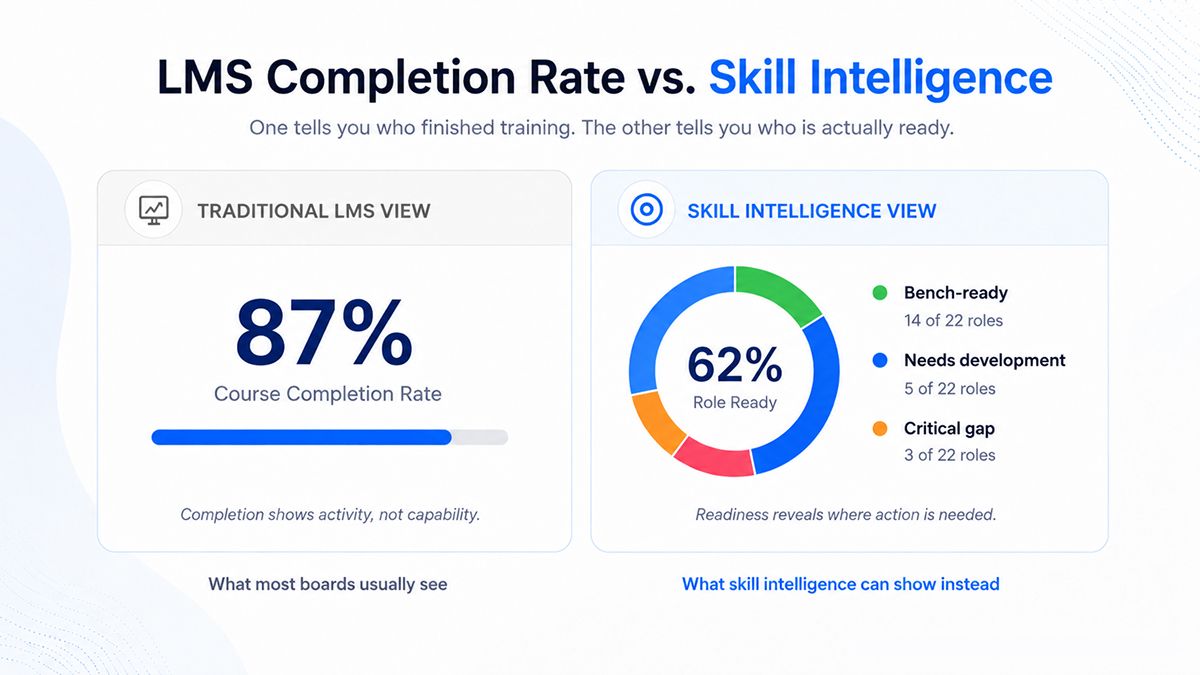
 

The slide most boards see, next to the slide a calibrated system can produce instead

There's a familiar moment in board meetings: the CHRO presents an L&D update, and the headline number is a completion rate. 87% completion this quarter. The board nods. Someone asks what it means for the business, and the honest answer is often thinner than the slide suggests; completion tells you people sat through content. It doesn't tell you whether the organization is any more capable of doing the work in front of it.

This isn't a failure of the CHRO presenting it. It's a failure of the system underneath the slide. Completion rate is what a traditional LMS is built to produce, so it's what gets reported; not because it's the most useful number, but because it's the only one readily available. Most L&D leaders would happily present role-readiness or capability data instead, if their platform could actually produce it with the same confidence.
 

The slide most boards see, next to the slide a calibrated system can produce instead

Why Completion Became the Default

The reliance on completion rate isn't arbitrary. It has a real justification for a narrow set of use cases: regulatory and compliance training generally does need to prove someone was exposed to specific content, on a specific date, and completion logs are a legitimate, necessary record for that purpose.

The problem is that completion tracking became the default lens for reporting on development broadly, not just compliance narrowly, because it was the easiest thing for an LMS to compute, the easiest thing to standardize across vendors, and the easiest thing to put on a slide. Once it became the default, it quietly became the only question most reporting infrastructure was built to answer.

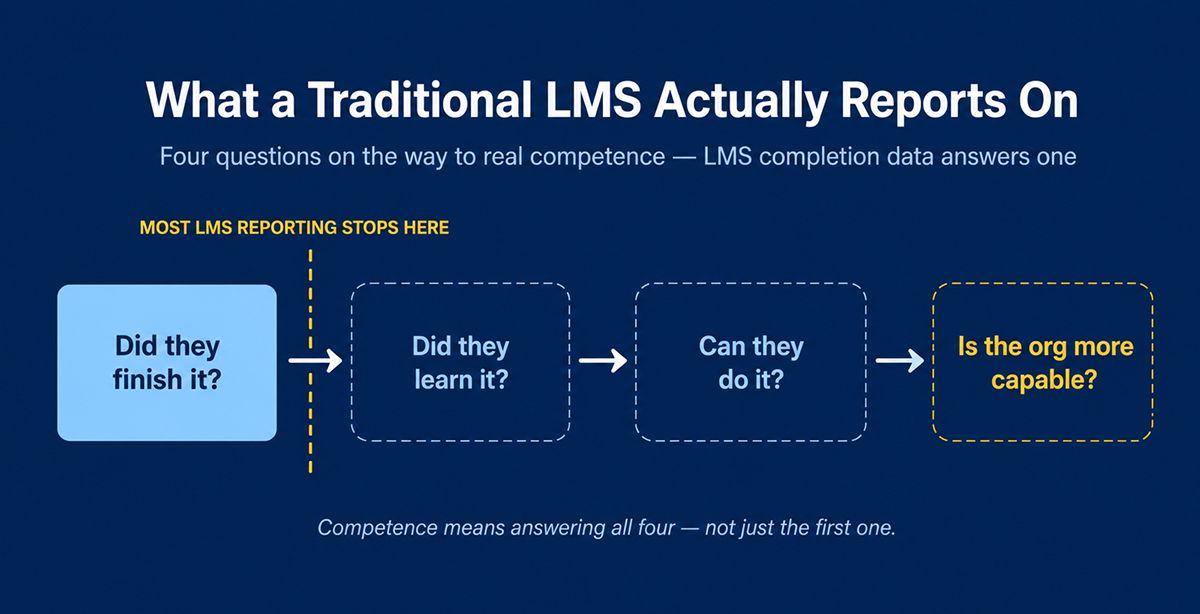
That's the gap worth naming directly: completion answers one question in a chain of four, and most organizations only ever built the infrastructure to answer the first one.


What a traditional LMS actually reports on — and where that reporting stops.

The reliance on completion rate isn't arbitrary. It has a real justification for a narrow set of use cases: regulatory and compliance training generally does need to prove someone was exposed to specific content, on a specific date, and completion logs are a legitimate, necessary record for that purpose.

The problem is that completion tracking became the default lens for reporting on development broadly, not just compliance narrowly, because it was the easiest thing for an LMS to compute, the easiest thing to standardize across vendors, and the easiest thing to put on a slide. Once it became the default, it quietly became the only question most reporting infrastructure was built to answer.

That's the gap worth naming directly: completion answers one question in a chain of four, and most organizations only ever built the infrastructure to answer the first one.


What a traditional LMS actually reports on — and where that reporting stops.

What Competence Actually Requires

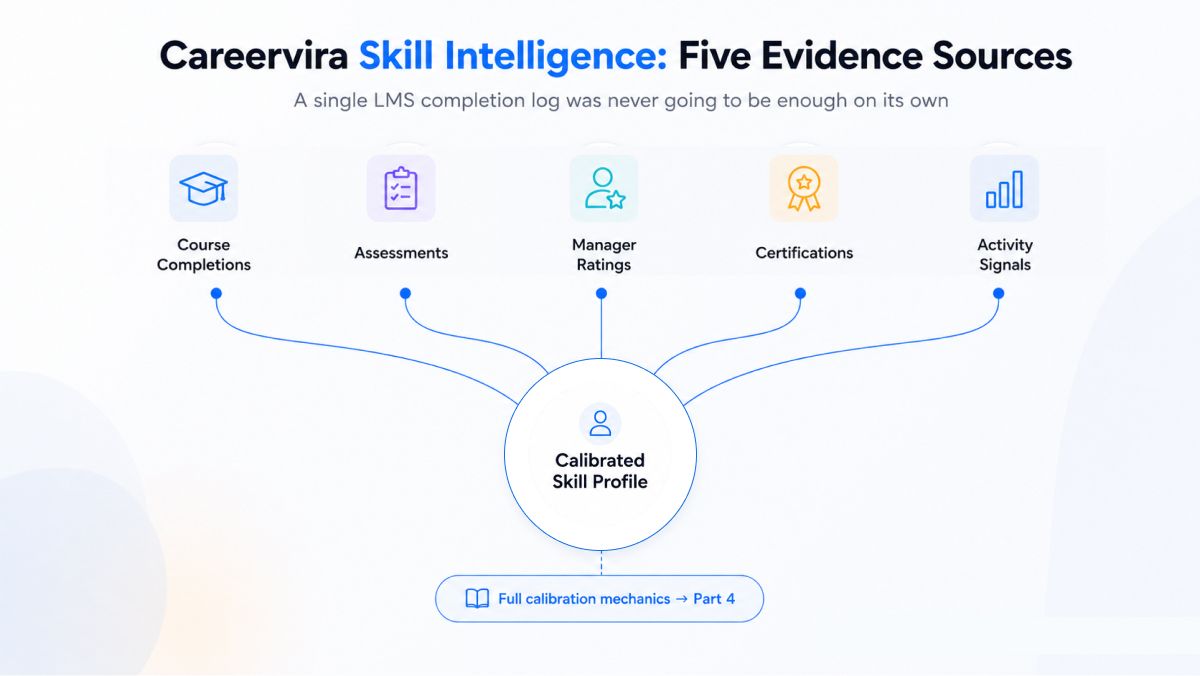
Answering the other three questions: did they learn it, can they do it, is the org more capable, requires evidence that no single system produces on its own. A completion log says someone opened and finished a course. It says nothing about whether they retained it, whether they can apply it under real conditions, or whether their proficiency has decayed since. Getting a real answer means triangulating signal from more than one place: assessments, manager observation, certifications, and real work activity all carry a piece of the picture that completion data alone doesn't.

This is a data-architecture requirement, not a reporting-dashboard requirement. It means the underlying system has to be built from the start to ingest, reconcile, and calibrate evidence from multiple sources into one profile, rather than bolting a nicer chart onto the same completion log everyone already has.


A calibrated skill profile draws on more than a completion log.


Organizations that make this shift tend to report a similar downstream effect: when development is genuinely tied to verified capability rather than course completion, the numbers that follow - retention, mobility, engagement — tend to move as well.


Answering the other three questions: did they learn it, can they do it, is the org more capable, requires evidence that no single system produces on its own. A completion log says someone opened and finished a course. It says nothing about whether they retained it, whether they can apply it under real conditions, or whether their proficiency has decayed since. Getting a real answer means triangulating signal from more than one place: assessments, manager observation, certifications, and real work activity all carry a piece of the picture that completion data alone doesn't.

This is a data-architecture requirement, not a reporting-dashboard requirement. It means the underlying system has to be built from the start to ingest, reconcile, and calibrate evidence from multiple sources into one profile, rather than bolting a nicer chart onto the same completion log everyone already has.


A calibrated skill profile draws on more than a completion log.


Organizations that make this shift tend to report a similar downstream effect: when development is genuinely tied to verified capability rather than course completion, the numbers that follow - retention, mobility, engagement — tend to move as well.


The Question Worth Asking Your Own Team

Before the next board update goes out, it's worth asking your own L&D function one question: if the board asked “how do you know,” not just “what's the number,” could we answer it? If the honest response is that the number comes from a single completion log, that's not a presentation problem; it's a data problem, and it's fixable at the architecture level before it needs to be fixed at the slide level.

Before the next board update goes out, it's worth asking your own L&D function one question: if the board asked “how do you know,” not just “what's the number,” could we answer it? If the honest response is that the number comes from a single completion log, that's not a presentation problem; it's a data problem, and it's fixable at the architecture level before it needs to be fixed at the slide level.

Before You Buy

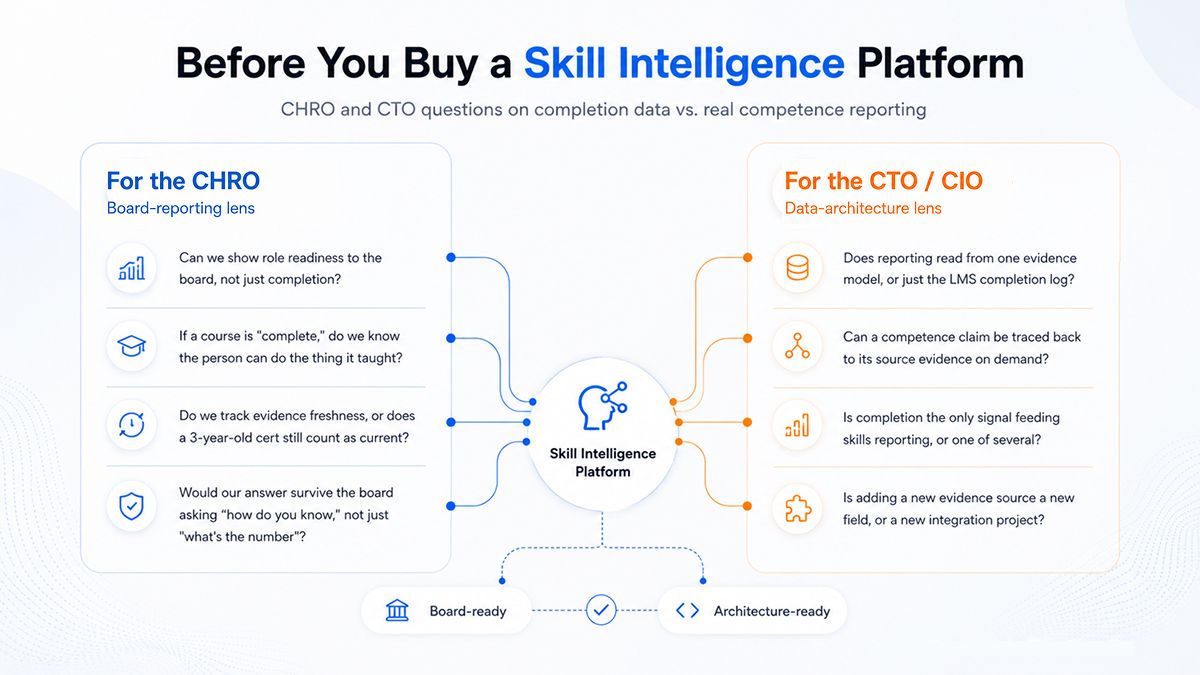
The completion-vs-competence gap shows up differently depending on which side of the table you're sitting on. A CHRO experiences it as a board-reporting credibility problem; a CTO experiences it as a data-modeling problem. Both are worth putting on the table in the same conversation.


 Eight questions, two lenses — what to ask before any vendor conversation ends.


The completion-vs-competence gap shows up differently depending on which side of the table you're sitting on. A CHRO experiences it as a board-reporting credibility problem; a CTO experiences it as a data-modeling problem. Both are worth putting on the table in the same conversation.


 Eight questions, two lenses — what to ask before any vendor conversation ends.


Features

Table of Contents

  • Description

  • The Slide Every CHRO Has Given

  • Why Completion Became the Default

  • What Competence Actually Requires

  • The Question Worth Asking Your Own Team

  • Before You Buy