The Fairness Audit Your Skills Platform Probably Can't Pass: Why Bias Correction Belongs in the Pipeline, Not a Policy Doc

Author Image

Vijay Singh

14 August 2026

Add To Wishlist

The Fairness Audit Your Skills Platform Probably Can't Pass: Why Bias Correction Belongs in the Pipeline, Not a Policy Doc

Discover why most skills platforms fail fairness audits and how to embed bias correction in the pipeline, not just policy, for defensible, equitable AI-driven L&D.

Features

Table of Contents

  • Description

  • A Skill Score Isn't Just a Product Feature Anymore

  • Bias Correction, Made Visible

  • Before You Buy

Discover why most skills platforms fail fairness audits and how to embed bias correction in the pipeline, not just policy, for defensible, equitable AI-driven L&D.

Description

Skill scores are quietly becoming the evidentiary basis for who gets promoted and who's called succession-ready, which makes them an HR-compliance surface, not just a product feature. Most platforms treat fairness as something to address after the fact, if a problem surfaces, rather than as an architectural requirement built into how the score is calculated in the first place. A CHRO evaluating any skills platform should be asking whether bias correction, decay modeling, and disparate-impact auditing are structural to the scoring engine; because a fairness gap here isn't a UX flaw, it's exposure.

A Skill Score Isn't Just a Product Feature Anymore

It's worth naming the stakes plainly before getting into mechanics: skill scores are increasingly the input to real decisions about real people's careers. A calibrated score feeds a promotion shortlist. The shortlist feeds a succession plan. The succession plan feeds a compensation conversation. By the time a number reaches that chain, nobody's asking where it came from; they're treating it as fact.

That chain is exactly why a skills platform's fairness architecture deserves the same scrutiny an organization would apply to any other system that influences pay and promotion. A dashboard glitch is a UX problem. A biased scoring pipeline that quietly favors employees with lenient managers is a fairness problem with a paper trail, or the lack of one.
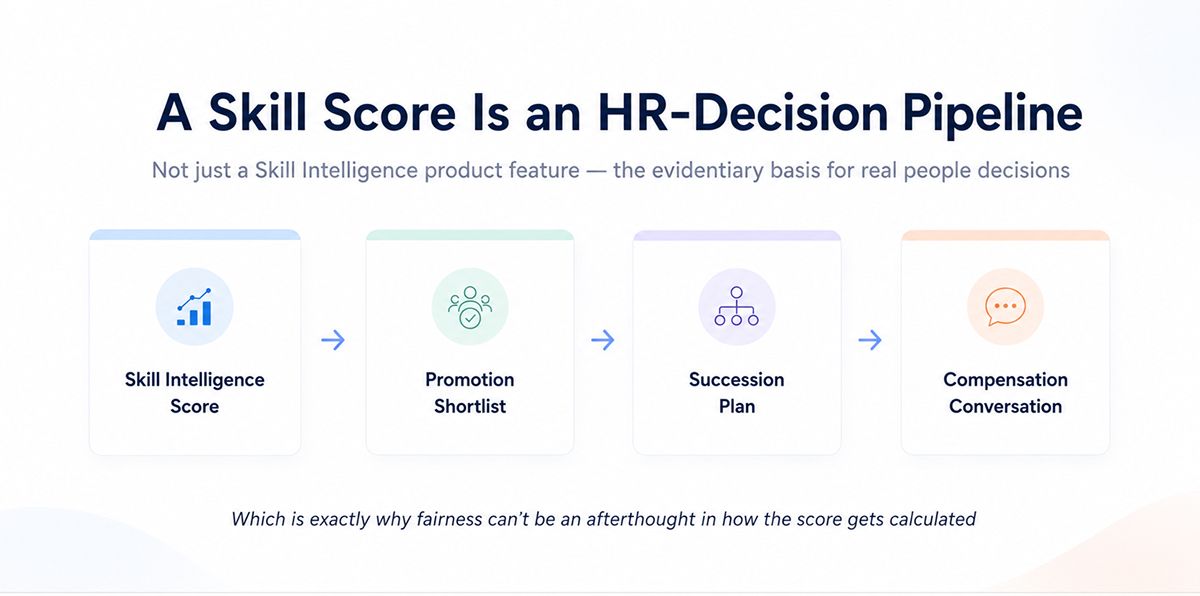
 

A skill score isn't the end of a workflow. It's the start of a decision chain.

It's worth naming the stakes plainly before getting into mechanics: skill scores are increasingly the input to real decisions about real people's careers. A calibrated score feeds a promotion shortlist. The shortlist feeds a succession plan. The succession plan feeds a compensation conversation. By the time a number reaches that chain, nobody's asking where it came from; they're treating it as fact.

That chain is exactly why a skills platform's fairness architecture deserves the same scrutiny an organization would apply to any other system that influences pay and promotion. A dashboard glitch is a UX problem. A biased scoring pipeline that quietly favors employees with lenient managers is a fairness problem with a paper trail, or the lack of one.
 

A skill score isn't the end of a workflow. It's the start of a decision chain.

What Fairness Built In Actually Looks Like

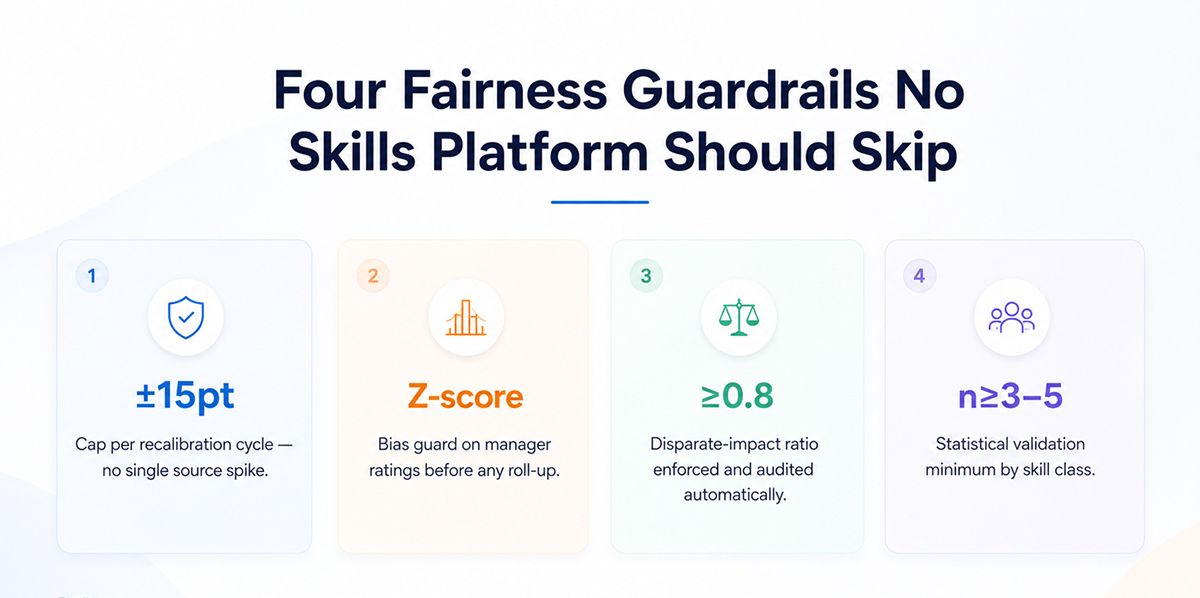
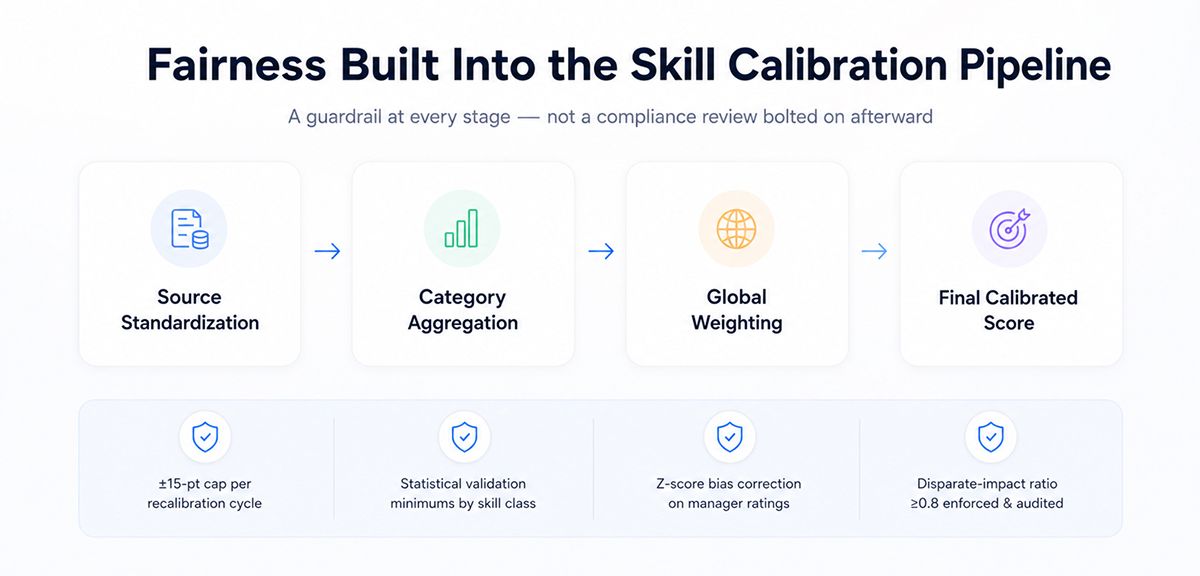
Most platforms treat fairness as a compliance review that happens after a score exists: an audit, a policy document, a promise. A genuinely fair scoring system treats fairness as an engineering constraint built into the calibration pipeline itself, with a specific guardrail active at every stage a signal passes through.

Concretely, that means: a hard cap on how far any single source can move someone's score in one cycle, so one outlier assessment or one manager's mood can't swing a career decision. Statistical validation minimums before a skill claim is trusted at all. Bias correction on manager ratings, so a strict rater and a lenient rater don't quietly produce different outcomes for equally capable people. And a disparate-impact ratio that gets measured and audited automatically, not manually, whenever the score is used for anything people-facing.


Fairness as an engineering constraint at every stage of the calibration pipeline, not a review at the end..

Most platforms treat fairness as a compliance review that happens after a score exists: an audit, a policy document, a promise. A genuinely fair scoring system treats fairness as an engineering constraint built into the calibration pipeline itself, with a specific guardrail active at every stage a signal passes through.

Concretely, that means: a hard cap on how far any single source can move someone's score in one cycle, so one outlier assessment or one manager's mood can't swing a career decision. Statistical validation minimums before a skill claim is trusted at all. Bias correction on manager ratings, so a strict rater and a lenient rater don't quietly produce different outcomes for equally capable people. And a disparate-impact ratio that gets measured and audited automatically, not manually, whenever the score is used for anything people-facing.


Fairness as an engineering constraint at every stage of the calibration pipeline, not a review at the end..

Bias Correction, Made Visible

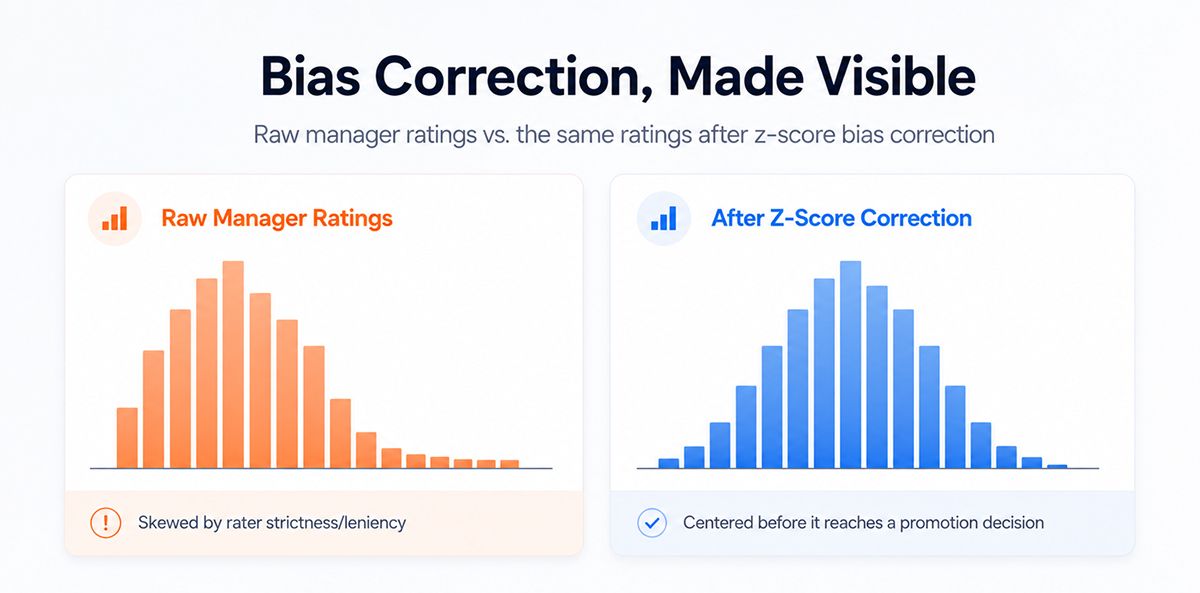
The clearest way to see why this matters is to look at what raw manager ratings actually look like before correction. Rating data is never perfectly clean; some managers are consistently generous, some are consistently tough, and neither pattern has anything to do with the people being rated. Left uncorrected, that skew becomes a permanent, invisible tax or subsidy on an employee's calibrated score, based entirely on who their manager is.

Z-score correction re-centers each manager's ratings against their own historical pattern before those ratings get blended into anyone's skill profile. The distribution on the right below isn't a different dataset; it's the same ratings, adjusted so that rater behavior is no longer a hidden variable in someone's career outcome.


The same manager-rating data, before and after bias correction. 


None of this replaces human judgment in a promotion decision; it just makes sure the number that judgment is informed by isn't quietly distorted before anyone sees it.


The clearest way to see why this matters is to look at what raw manager ratings actually look like before correction. Rating data is never perfectly clean; some managers are consistently generous, some are consistently tough, and neither pattern has anything to do with the people being rated. Left uncorrected, that skew becomes a permanent, invisible tax or subsidy on an employee's calibrated score, based entirely on who their manager is.

Z-score correction re-centers each manager's ratings against their own historical pattern before those ratings get blended into anyone's skill profile. The distribution on the right below isn't a different dataset; it's the same ratings, adjusted so that rater behavior is no longer a hidden variable in someone's career outcome.


The same manager-rating data, before and after bias correction. 


None of this replaces human judgment in a promotion decision; it just makes sure the number that judgment is informed by isn't quietly distorted before anyone sees it.


Before You Buy

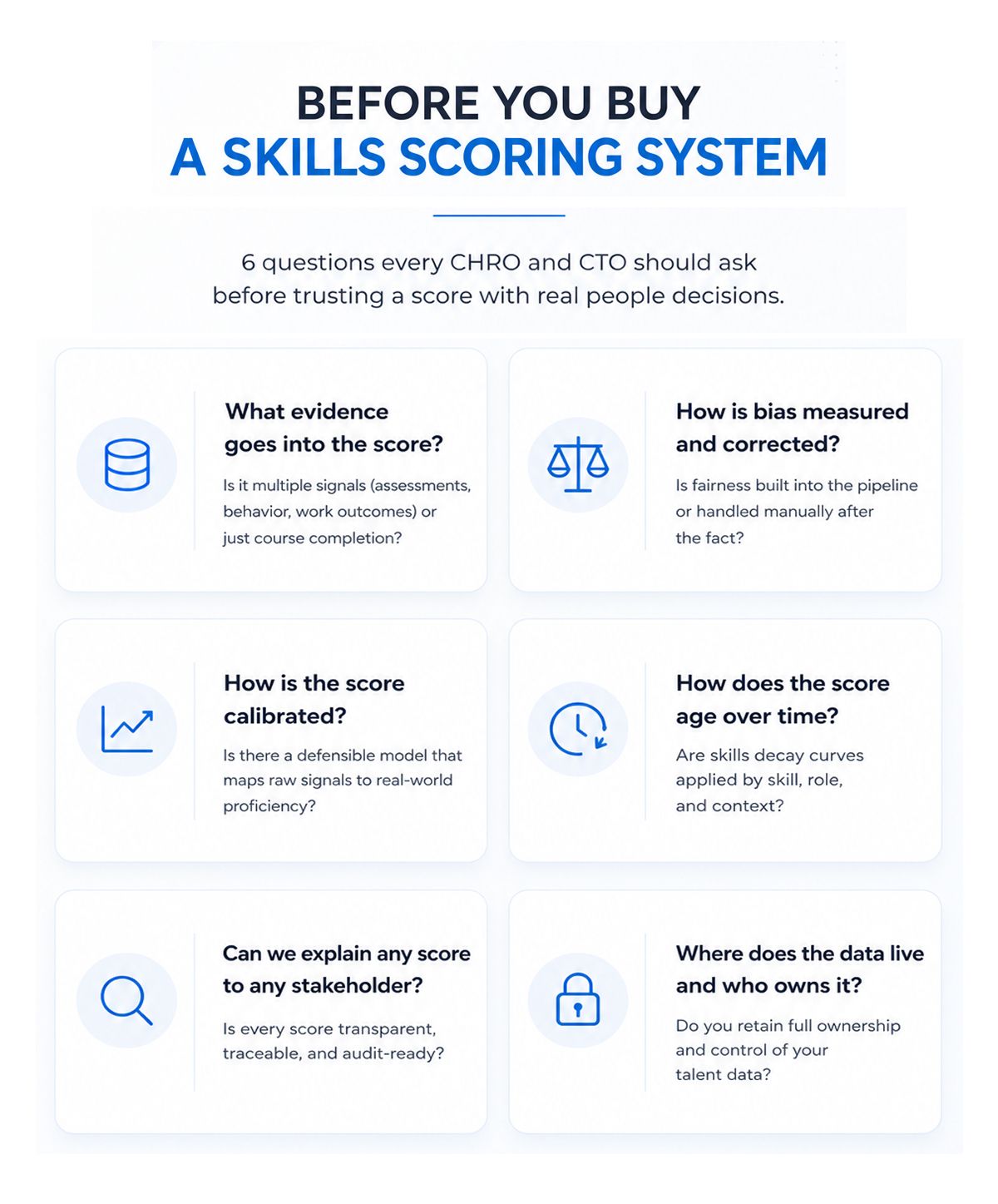
Fairness questions land differently depending on the seat. A CHRO needs the scoring process to survive a formal challenge to a promotion decision. A CTO needs to know whether fairness is enforced in the pipeline itself or only visible in a report generated after the fact, which is a very different, and much weaker, guarantee.


Eight questions, two lenses — what to ask before any vendor conversation ends.


Fairness questions land differently depending on the seat. A CHRO needs the scoring process to survive a formal challenge to a promotion decision. A CTO needs to know whether fairness is enforced in the pipeline itself or only visible in a report generated after the fact, which is a very different, and much weaker, guarantee.


Eight questions, two lenses — what to ask before any vendor conversation ends.


Features

Table of Contents

  • Description

  • A Skill Score Isn't Just a Product Feature Anymore

  • Bias Correction, Made Visible

  • Before You Buy