10 Best Learning Experience Platforms (LXP) in India for 2026: The Complete Guide

Author Image

Vijay Singh

05 October 2026

Add To Wishlist

10 Best Learning Experience Platforms (LXP) in India for 2026: The Complete Guide

Discover the 10 best Learning Experience Platforms (LXPs) in India for 2026, comparing AI personalization, skills intelligence, integrations, pricing, and enterprise fit.

Features

Table of Contents

  • Description

  • What is a Learning Experience Platform?

  • The LMS Baseline Test and Where AI Fits

  • The LXP Completeness Benchmark

  • The Top 10 Learning Experience Platforms

  • What Makes Careervira's LXP Best in Class

  • USP Comparison Table

  • Frequently Asked Questions

  • Conclusion: The Future of LXPs in India

Discover the 10 best Learning Experience Platforms (LXPs) in India for 2026, comparing AI personalization, skills intelligence, integrations, pricing, and enterprise fit.

Description

As workforces become increasingly digitally connected and skills needs change at a faster pace, organisations need learning experiences that feel relevant, engaging and personalised – not just another repository of courses. This is where Learning Experience Platforms (LXPs) are gaining traction with HR and L&D teams.

But an LXP is a layer in a larger learning ecosystem, not a replacement for an LMS. In this guide, we examine the top 10 LXPs in India for 2026, looking at the factors that matter for enterprise adoption: personalisation, skills intelligence, content curation, integrations, and impact on the long-term workforce.

What is a Learning Experience Platform?

A Learning Experience Platform is a means to curate, personalise, and make discoverable learning content an organization already has or can source. It is not a system of record by itself. An LMS can track courses, generate compliance reports, and handle certifications. An LXP is either built on or alongside an LMS, turning a basic delivery of raw content into a truly personalized experience. An LXP sits on top of or next to an LMS and transforms a simple delivery of raw content into a truly personalised experience.

A Learning Experience Platform is a means to curate, personalise, and make discoverable learning content an organization already has or can source. It is not a system of record by itself. An LMS can track courses, generate compliance reports, and handle certifications. An LXP is either built on or alongside an LMS, turning a basic delivery of raw content into a truly personalized experience. An LXP sits on top of or next to an LMS and transforms a simple delivery of raw content into a truly personalised experience.

The LMS Baseline Test and Where AI Fits

Argument 1: An LXP is a Content Feed, Not a Learning System Without an LMS Foundation

Personalization, curation, and social learning are worth nothing without an underlying delivery engine that tracks completion, runs compliance, and reports on outcomes. Some of the platforms on this list are strong LXPs with a real gap underneath: no native LMS at any price, which means the buyer needs a second platform — a second vendor, a second contract — just to deliver what the LXP recommends. Before comparing personalization engines, ask the more basic question: does this platform's parent company sell you an LMS at all, or only the layer on top of one you don't yet have?


Argument 2: Skill Intelligence and Agentic AI Are the Advanced Tier, Not the Baseline

The most sophisticated LXPs are built on calibrated skill data (HRMS, ATS, assessments, true work activity), not course completion history, and the most advanced platforms can act on that data (automated career orchestration, governed interventions), not just recommend. That’s real and worth knowing about, but that’s the advanced layer on top of the baseline this article is substantively about. Most buyers evaluating “best LXP” are still deciding whether the fundamentals (personalization, curation, social learning, career pathing, mobile, analytics) are solid on a real LMS foundation. For a full breakdown of the AI capability, personalisation architecture, career orchestration autonomy, and content curation AI, please refer to the companion guide, Best AI-Powered LXP in India for 2026.


What to Look Forward to in 2026

  • Native LMS underneath, or a second platform required to deliver what's recommended?
  • Personalization depth — generic/role-based vs. truly skill-gap-based
  • Content curation & aggregation – single source or broad multi-source, internal & external
  • Social and collaborative learning — forums, peer review, cohort discussion
  • Career pathing — basic role suggestions vs. structured path planning
  • Mobile-first delivery and analytics depth
  • Pricing transparency — published rates vs. quote-only

Argument 1: An LXP is a Content Feed, Not a Learning System Without an LMS Foundation

Personalization, curation, and social learning are worth nothing without an underlying delivery engine that tracks completion, runs compliance, and reports on outcomes. Some of the platforms on this list are strong LXPs with a real gap underneath: no native LMS at any price, which means the buyer needs a second platform — a second vendor, a second contract — just to deliver what the LXP recommends. Before comparing personalization engines, ask the more basic question: does this platform's parent company sell you an LMS at all, or only the layer on top of one you don't yet have?


Argument 2: Skill Intelligence and Agentic AI Are the Advanced Tier, Not the Baseline

The most sophisticated LXPs are built on calibrated skill data (HRMS, ATS, assessments, true work activity), not course completion history, and the most advanced platforms can act on that data (automated career orchestration, governed interventions), not just recommend. That’s real and worth knowing about, but that’s the advanced layer on top of the baseline this article is substantively about. Most buyers evaluating “best LXP” are still deciding whether the fundamentals (personalization, curation, social learning, career pathing, mobile, analytics) are solid on a real LMS foundation. For a full breakdown of the AI capability, personalisation architecture, career orchestration autonomy, and content curation AI, please refer to the companion guide, Best AI-Powered LXP in India for 2026.


What to Look Forward to in 2026

  • Native LMS underneath, or a second platform required to deliver what's recommended?
  • Personalization depth — generic/role-based vs. truly skill-gap-based
  • Content curation & aggregation – single source or broad multi-source, internal & external
  • Social and collaborative learning — forums, peer review, cohort discussion
  • Career pathing — basic role suggestions vs. structured path planning
  • Mobile-first delivery and analytics depth
  • Pricing transparency — published rates vs. quote-only

The LXP Completeness Benchmark

Scored on the 7 baseline dimensions above, deliberately excluding Skill Intelligence and Agentic AI, which get their own dedicated benchmark in the companion AI-Powered LXP guide. This keeps the two articles distinct rather than duplicating ground.

PlatformNative LMSPersonal.CurationSocialCareer PathMobile/AnalyticsPricingTotal /14
Careervira LXP222122213
Cornerstone LXP22111209
Docebo22210209
Degreed02212108
Disprz22101208
Oracle Fusion Cloud Learning21102208
360Learning11120117
TalentLMS20100227
LinkedIn Learning01101115
Udemy Business01100215

Scores reflect publicly available information as of August 2026 and sourced facts already maintained in this estate's battlecards — confirm current feature scope directly with each vendor before publishing.

Scored on the 7 baseline dimensions above, deliberately excluding Skill Intelligence and Agentic AI, which get their own dedicated benchmark in the companion AI-Powered LXP guide. This keeps the two articles distinct rather than duplicating ground.

PlatformNative LMSPersonal.CurationSocialCareer PathMobile/AnalyticsPricingTotal /14
Careervira LXP222122213
Cornerstone LXP22111209
Docebo22210209
Degreed02212108
Disprz22101208
Oracle Fusion Cloud Learning21102208
360Learning11120117
TalentLMS20100227
LinkedIn Learning01101115
Udemy Business01100215

Scores reflect publicly available information as of August 2026 and sourced facts already maintained in this estate's battlecards — confirm current feature scope directly with each vendor before publishing.

The Top 10 Learning Experience Platforms

1. Careervira LXP — 13/14

The only platform on this list with a native LMS underneath the personalization layer, plus content curation at scale (80,000+ titles across 20+ providers, BYOC included), native career pathing, and published pricing, clearing the baseline test on every dimension except social learning, where cohort- and mentor-based collaboration is real but less forum-centric than a platform like 360Learning.

  • Native LMS + LXP on one data model — no second platform required
  • Skill-gap-based personalization, not just role or profile-based
  • 80,000+ marketplace titles across 20+ content providers, with BYOC support
  • Native career pathing with a full IDP intervention menu
  • Published, transparent pricing: $2–$20/user/month, scaling to a published AI Role Automation tier at $100–$200/user/month; see the companion AI-Powered LXP guide for the advanced-tier details.


2. Cornerstone LXP — 9/14

Full talent suite with a real LMS underneath (passes the baseline test cleanly), plus strong analytics and social/collaboration tools under the Cornerstone Galaxy brand, now including Cornerstone Immerse (VR/desktop roleplay) and SkyHive-powered skills intelligence. Career pathing is role-mapping only, not full mobility planning, and pricing is all quote-based.

  • Native LMS (Cornerstone Learn), part of a comprehensive talent suite
  • Adaptive, SkyHive-powered content delivery, plus Immerse VR/desktop roleplay training
  • Real-time analytics and reporting
  • Quote-based pricing throughout


3. Docebo — 9/14

A real full LMS with strong AI-driven curation and a real content marketplace does a nice clean-up of the baseline, now extended by AgentHub (via the Zive acquisition) for document-to-course automation, and a 365Talents-powered skills layer. Pricing is quote-based, and career pathing/mobility is not a core strength.

  • Native, full LMS — clears the baseline test
  • AgentHub-automated content curation plus Harmony marketplace integrations
  • Limited career pathing — not a primary strength
  • Quote-based, active-user pricing


4. Degreed — 8/14

The strongest pure-play content aggregation on this list (800+ integrations, now extended by Open Library's 500+ curated pathways) and an actual individual-development-planning capability, but the one gap that matters most for this article's core test: no native LMS at any price tier, meaning delivery still needs a second platform.

  • No native LMS at any price — fails the baseline test on its own
  • Strongest content aggregation in the category (800+ integrations, Open Library)
  • Real IDP and mobility features, rated Strong on career pathing
  • Pricing transparency rated Low


5. Disprz — 8/14

A genuine native LMS+LXP combination that clears the baseline test cleanly, with strong, role-based AI personalization and Turo's document-to-course content generation. Social/collaborative learning isn't a documented focus, career pathing is role-mapping only, and pricing transparency is independently rated Low.

  • Native LMS + LXP — clears the baseline test
  • Strong AI-powered role-based personalization
  • Turo: converts SOPs/PDFs into interactive content
  • Mobile-first design, strong for frontline and multilingual workforces


6. Oracle Fusion Cloud Learning — 8/14

A native HCM module that clears the baseline test cleanly, with Oracle Grow adding a true, if HCM-bounded, career-development layer: self-curated development playlists, mentor coaching, gigs, and formal learning tied to performance goals. Content curation is partner-feed aggregation rather than an owned marketplace, social learning isn't a documented focus, and pricing isn't published; it's bundled into the broader Oracle HCM Cloud contract.

  • Native LMS — clears the baseline test, deeply embedded in Oracle Fusion HCM Cloud
  • Oracle Grow: real career journeys, mentoring, and gigs tied to performance goals
  • Skills Center + Job Skills Enrichment Agent for recommender-driven skill suggestions
  • Content aggregation via partner feeds (Skillsoft, LinkedIn Learning), not an owned marketplace


7. 360Learning — 7/14

The strongest social/collaborative learning on this list, with peer-driven course creation and discussion really core to the product, now paired with real generative-AI authoring tools (AI Course Creation, AI Companion, Synthesia video avatars). Delivery is partial and authoring-led rather than a full enterprise LMS, and career pathing.

  • Authoring-led delivery — partial LMS baseline, not full enterprise-grade
  • Strongest peer-driven, collaborative learning in this list, now with AI-assisted authoring
  • Limited career pathing
  • Tiered, largely quote-based pricing


8. TalentLMS — 7/14

A native, full LMS with fast, transparent deployment, TalentCraft AI content generation, and the field's strongest pricing transparency; but no skill-graph-based personalization layer, and career pathing and social learning aren't documented product focuses.

  • Native LMS — clears the baseline test
  • TalentCraft AI content creator and TalentLibrary (750+ courses)
  • Published, transparent per-user pricing — the most pricing-transparent platform in this list
  • No skill-graph personalization or career-pathing depth documented


9. LinkedIn Learning — 5/14

A vast, single-source content library (17,000+ courses) with LinkedIn-profile-based personalization and credential badging on profile, useful for individual upskilling, but with no native LMS, minimal social/collaborative tooling, and only basic career pathing tied to profile data.

  • No native LMS — content library, not a delivery/compliance system
  • Profile-based personalization, not skill-gap calibrated
  • Minimal social/collaborative learning


10. Udemy Business — 5/14

A large single marketplace with solid mobile delivery and analytics, but no native LMS, minimal social learning, and career pathing isn't a product focus.

  • No native LMS — course library model
  • Large single-source catalog, not multi-source aggregation
  • Career pathing not a focus

1. Careervira LXP — 13/14

The only platform on this list with a native LMS underneath the personalization layer, plus content curation at scale (80,000+ titles across 20+ providers, BYOC included), native career pathing, and published pricing, clearing the baseline test on every dimension except social learning, where cohort- and mentor-based collaboration is real but less forum-centric than a platform like 360Learning.

  • Native LMS + LXP on one data model — no second platform required
  • Skill-gap-based personalization, not just role or profile-based
  • 80,000+ marketplace titles across 20+ content providers, with BYOC support
  • Native career pathing with a full IDP intervention menu
  • Published, transparent pricing: $2–$20/user/month, scaling to a published AI Role Automation tier at $100–$200/user/month; see the companion AI-Powered LXP guide for the advanced-tier details.


2. Cornerstone LXP — 9/14

Full talent suite with a real LMS underneath (passes the baseline test cleanly), plus strong analytics and social/collaboration tools under the Cornerstone Galaxy brand, now including Cornerstone Immerse (VR/desktop roleplay) and SkyHive-powered skills intelligence. Career pathing is role-mapping only, not full mobility planning, and pricing is all quote-based.

  • Native LMS (Cornerstone Learn), part of a comprehensive talent suite
  • Adaptive, SkyHive-powered content delivery, plus Immerse VR/desktop roleplay training
  • Real-time analytics and reporting
  • Quote-based pricing throughout


3. Docebo — 9/14

A real full LMS with strong AI-driven curation and a real content marketplace does a nice clean-up of the baseline, now extended by AgentHub (via the Zive acquisition) for document-to-course automation, and a 365Talents-powered skills layer. Pricing is quote-based, and career pathing/mobility is not a core strength.

  • Native, full LMS — clears the baseline test
  • AgentHub-automated content curation plus Harmony marketplace integrations
  • Limited career pathing — not a primary strength
  • Quote-based, active-user pricing


4. Degreed — 8/14

The strongest pure-play content aggregation on this list (800+ integrations, now extended by Open Library's 500+ curated pathways) and an actual individual-development-planning capability, but the one gap that matters most for this article's core test: no native LMS at any price tier, meaning delivery still needs a second platform.

  • No native LMS at any price — fails the baseline test on its own
  • Strongest content aggregation in the category (800+ integrations, Open Library)
  • Real IDP and mobility features, rated Strong on career pathing
  • Pricing transparency rated Low


5. Disprz — 8/14

A genuine native LMS+LXP combination that clears the baseline test cleanly, with strong, role-based AI personalization and Turo's document-to-course content generation. Social/collaborative learning isn't a documented focus, career pathing is role-mapping only, and pricing transparency is independently rated Low.

  • Native LMS + LXP — clears the baseline test
  • Strong AI-powered role-based personalization
  • Turo: converts SOPs/PDFs into interactive content
  • Mobile-first design, strong for frontline and multilingual workforces


6. Oracle Fusion Cloud Learning — 8/14

A native HCM module that clears the baseline test cleanly, with Oracle Grow adding a true, if HCM-bounded, career-development layer: self-curated development playlists, mentor coaching, gigs, and formal learning tied to performance goals. Content curation is partner-feed aggregation rather than an owned marketplace, social learning isn't a documented focus, and pricing isn't published; it's bundled into the broader Oracle HCM Cloud contract.

  • Native LMS — clears the baseline test, deeply embedded in Oracle Fusion HCM Cloud
  • Oracle Grow: real career journeys, mentoring, and gigs tied to performance goals
  • Skills Center + Job Skills Enrichment Agent for recommender-driven skill suggestions
  • Content aggregation via partner feeds (Skillsoft, LinkedIn Learning), not an owned marketplace


7. 360Learning — 7/14

The strongest social/collaborative learning on this list, with peer-driven course creation and discussion really core to the product, now paired with real generative-AI authoring tools (AI Course Creation, AI Companion, Synthesia video avatars). Delivery is partial and authoring-led rather than a full enterprise LMS, and career pathing.

  • Authoring-led delivery — partial LMS baseline, not full enterprise-grade
  • Strongest peer-driven, collaborative learning in this list, now with AI-assisted authoring
  • Limited career pathing
  • Tiered, largely quote-based pricing


8. TalentLMS — 7/14

A native, full LMS with fast, transparent deployment, TalentCraft AI content generation, and the field's strongest pricing transparency; but no skill-graph-based personalization layer, and career pathing and social learning aren't documented product focuses.

  • Native LMS — clears the baseline test
  • TalentCraft AI content creator and TalentLibrary (750+ courses)
  • Published, transparent per-user pricing — the most pricing-transparent platform in this list
  • No skill-graph personalization or career-pathing depth documented


9. LinkedIn Learning — 5/14

A vast, single-source content library (17,000+ courses) with LinkedIn-profile-based personalization and credential badging on profile, useful for individual upskilling, but with no native LMS, minimal social/collaborative tooling, and only basic career pathing tied to profile data.

  • No native LMS — content library, not a delivery/compliance system
  • Profile-based personalization, not skill-gap calibrated
  • Minimal social/collaborative learning


10. Udemy Business — 5/14

A large single marketplace with solid mobile delivery and analytics, but no native LMS, minimal social learning, and career pathing isn't a product focus.

  • No native LMS — course library model
  • Large single-source catalog, not multi-source aggregation
  • Career pathing not a focus

What Makes Careervira's LXP Best in Class

The pillar table above says Careervira clears the baseline test. This section says what that architecture clearly does once a team is using it: the two capabilities that turn “has an LXP layer” into “the LXP layer people actually finish what it recommends.”

How Careervira's LXP Maps Content to Roles and Skills

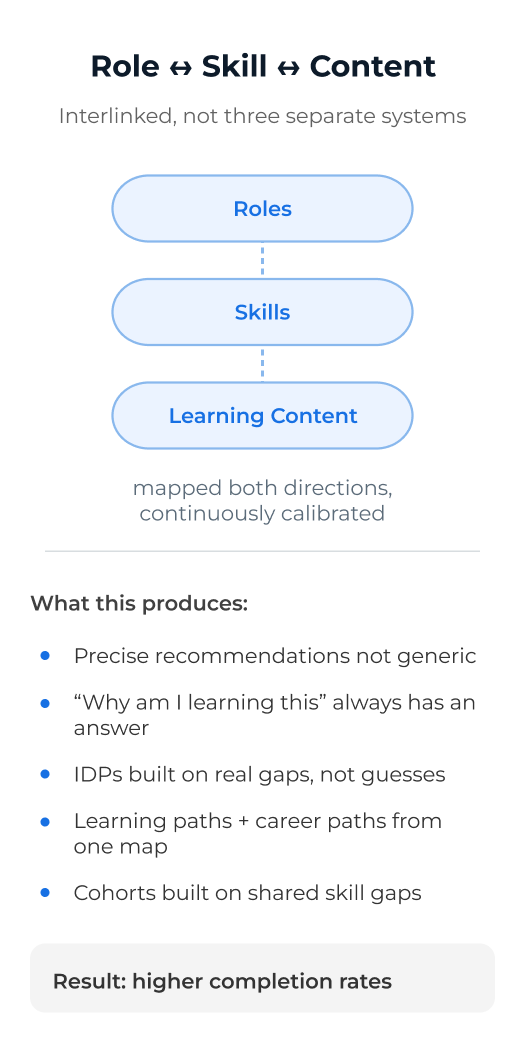
Most LXPs personalize from click history or job title alone. Careervira's model interlinks roles, skills, and learning content in both directions, continuously calibrated, not three separate systems that happen to share a login.


Interlinked, not three separate systems — mapped in both directions, continuously.


The practical effect: a learner’s “why am I learning this” question always has a traceable answer, an IDP reflects a legitimate, corroborated gap rather than a templated plan for the job title, and a cohort can be built on a shared skill gap rather than a shared org-chart box. Recommendations are not generic but are mapped precisely so the learners know why they are being asked to take a particular course, and that is what leads to higher completion rates, not just a larger library.


Four Content Types, One Filtering Layer

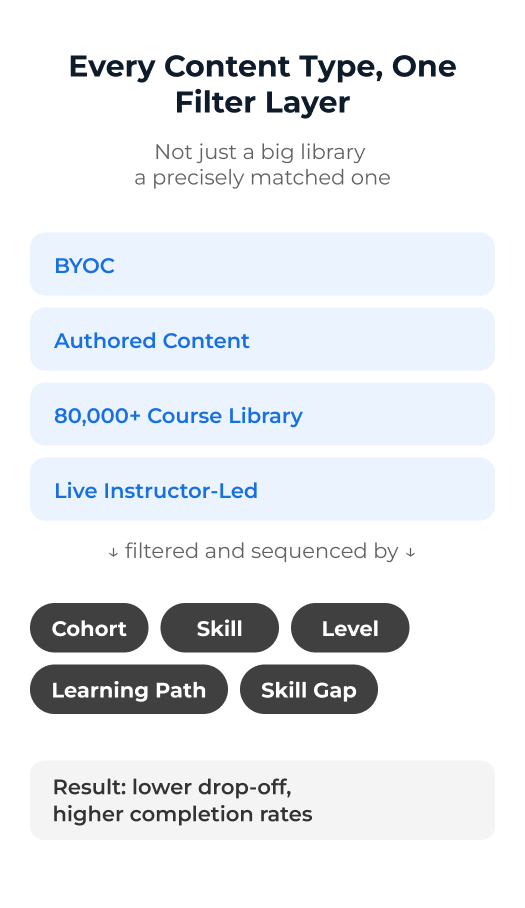
A large course library with no mapping produces choice paralysis. The Careervira marketplace offers all four content types an LXP can deliver: a library of licensed courses (80,000+ courses from 20+ providers), bring-your-own-content, native authoring tools, and a live-instructor marketplace, all on the same cohort, skill, level, learning-path, and skill-gap filtering layer.


Not just a big library — every content type filtered by the same mapping layer.


That’s the differentiator to call out directly: most of the platforms in this comparison have one or two of these four types of content, not all four through one consistent layer. As the library of content grows, instead of becoming harder to navigate, the learner is given a small, precisely relevant shortlist rather than a large, undifferentiated catalog, keeping drop-off down and completion rates up.

The pillar table above says Careervira clears the baseline test. This section says what that architecture clearly does once a team is using it: the two capabilities that turn “has an LXP layer” into “the LXP layer people actually finish what it recommends.”

How Careervira's LXP Maps Content to Roles and Skills

Most LXPs personalize from click history or job title alone. Careervira's model interlinks roles, skills, and learning content in both directions, continuously calibrated, not three separate systems that happen to share a login.


Interlinked, not three separate systems — mapped in both directions, continuously.


The practical effect: a learner’s “why am I learning this” question always has a traceable answer, an IDP reflects a legitimate, corroborated gap rather than a templated plan for the job title, and a cohort can be built on a shared skill gap rather than a shared org-chart box. Recommendations are not generic but are mapped precisely so the learners know why they are being asked to take a particular course, and that is what leads to higher completion rates, not just a larger library.


Four Content Types, One Filtering Layer

A large course library with no mapping produces choice paralysis. The Careervira marketplace offers all four content types an LXP can deliver: a library of licensed courses (80,000+ courses from 20+ providers), bring-your-own-content, native authoring tools, and a live-instructor marketplace, all on the same cohort, skill, level, learning-path, and skill-gap filtering layer.


Not just a big library — every content type filtered by the same mapping layer.


That’s the differentiator to call out directly: most of the platforms in this comparison have one or two of these four types of content, not all four through one consistent layer. As the library of content grows, instead of becoming harder to navigate, the learner is given a small, precisely relevant shortlist rather than a large, undifferentiated catalog, keeping drop-off down and completion rates up.

USP Comparison Table

This table compares leading LXPs across seven key dimensions: native LMS capability, personalization, content curation, social learning, career pathing, pricing, and best-fit use cases.

PlatformNative LMS UnderneathPersonalizationContent CurationSocial LearningCareer PathingPricingBest For
LinkedIn LearningNo: content libraryProfile-basedSingle large library (17,000+)MinimalBasicSubscriptionIndividual professional development
Cornerstone LXPYes, full talent suiteSkyHive-powered, adaptiveModerate, plus Immerse VR contentForums, collaborationRole mapping onlyQuote-basedLarge, regulated enterprises
360LearningPartial: authoring-ledAI Companion, not skill-graph basedPeer-driven creation + AI authoringStrong: core strengthLimitedTiered, quote-basedCollaborative team learning
DoceboYes, full LMS365Talents-powered, adaptiveAgentHub-automated + marketplaceUser-generated contentLimitedQuote-basedLarge orgs, automation
DegreedNo: at any price tierStrong, activity-led, Maestro AIStrongest aggregation, 800+ sources + Open LibrarySharing featuresReal IDP/mobilityLow transparencyMulti-source upskilling
DisprzYes, native LMS+LXPStrong, role-based (Turo AI)Standard library + Turo content generationNot a core focusPartial: role mapping onlyTiered, low transparencyFrontline & multilingual workforces
Oracle Fusion Cloud LearningYes, native HCM moduleSkills Center + Job Skills Enrichment Agent, HCM-boundedPartner-feed aggregation (Skillsoft, LinkedIn Learning)Not a core focusOracle Grow: mentoring, gigs, genuine career journeysNot published, bundled into Oracle HCM licensingOrganizations already on Oracle Fusion HCM Cloud
TalentLMSYes, native LMSNot skill-graph calibratedTalentLibrary (750+) + TalentCraft AINot a core focusNot a focusPublished, transparentSMEs, fast deployment
Udemy BusinessNo: course libraryGeneric AI recommendationsSingle large marketplaceMinimalNot a focusTieredFast, broad skill coverage
Careervira LXPYes, nativeSkill-gap-based, calibrated80,000+ titles, 20+ providers, BYOCCohort + mentor matchingNative, full IDP menuPublished, $2–$20/user/monthOrgs wanting LMS + LXP as one system

Pricing and feature details for the 9 named competitor platforms reflect publicly available reviews, directories, and vendor materials as of August 2026 and may have changed — confirm current terms directly with each vendor.

This table compares leading LXPs across seven key dimensions: native LMS capability, personalization, content curation, social learning, career pathing, pricing, and best-fit use cases.

PlatformNative LMS UnderneathPersonalizationContent CurationSocial LearningCareer PathingPricingBest For
LinkedIn LearningNo: content libraryProfile-basedSingle large library (17,000+)MinimalBasicSubscriptionIndividual professional development
Cornerstone LXPYes, full talent suiteSkyHive-powered, adaptiveModerate, plus Immerse VR contentForums, collaborationRole mapping onlyQuote-basedLarge, regulated enterprises
360LearningPartial: authoring-ledAI Companion, not skill-graph basedPeer-driven creation + AI authoringStrong: core strengthLimitedTiered, quote-basedCollaborative team learning
DoceboYes, full LMS365Talents-powered, adaptiveAgentHub-automated + marketplaceUser-generated contentLimitedQuote-basedLarge orgs, automation
DegreedNo: at any price tierStrong, activity-led, Maestro AIStrongest aggregation, 800+ sources + Open LibrarySharing featuresReal IDP/mobilityLow transparencyMulti-source upskilling
DisprzYes, native LMS+LXPStrong, role-based (Turo AI)Standard library + Turo content generationNot a core focusPartial: role mapping onlyTiered, low transparencyFrontline & multilingual workforces
Oracle Fusion Cloud LearningYes, native HCM moduleSkills Center + Job Skills Enrichment Agent, HCM-boundedPartner-feed aggregation (Skillsoft, LinkedIn Learning)Not a core focusOracle Grow: mentoring, gigs, genuine career journeysNot published, bundled into Oracle HCM licensingOrganizations already on Oracle Fusion HCM Cloud
TalentLMSYes, native LMSNot skill-graph calibratedTalentLibrary (750+) + TalentCraft AINot a core focusNot a focusPublished, transparentSMEs, fast deployment
Udemy BusinessNo: course libraryGeneric AI recommendationsSingle large marketplaceMinimalNot a focusTieredFast, broad skill coverage
Careervira LXPYes, nativeSkill-gap-based, calibrated80,000+ titles, 20+ providers, BYOCCohort + mentor matchingNative, full IDP menuPublished, $2–$20/user/monthOrgs wanting LMS + LXP as one system

Pricing and feature details for the 9 named competitor platforms reflect publicly available reviews, directories, and vendor materials as of August 2026 and may have changed — confirm current terms directly with each vendor.

Frequently Asked Questions

1. What is the difference between an LXP and LMS?

LMS – training delivery, tracking & reporting – compliance, completion, certification. An LXP is personalized, often curated for next steps in learning, and has social/collaborative features. Most businesses need both. Some LXPs have a native LMS; some need a separate one.

2. Is LXP a full replacement for LMS?

Not for compliance-oriented organizations. An LXP cannot deliver mandatory training, certification renewal, or audit-ready compliance reporting by itself – those are LMS functions, regardless of the platform used to deliver and track them.

3. How much does an LXP typically cost?

Pricing varies widely, and most vendors on this list are quote-based rather than publishing rates — itself a useful signal when comparing platforms. Published pricing usually scales with the number of seats and feature tier. Please check current terms directly with the vendor.

1. What is the difference between an LXP and LMS?

LMS – training delivery, tracking & reporting – compliance, completion, certification. An LXP is personalized, often curated for next steps in learning, and has social/collaborative features. Most businesses need both. Some LXPs have a native LMS; some need a separate one.

2. Is LXP a full replacement for LMS?

Not for compliance-oriented organizations. An LXP cannot deliver mandatory training, certification renewal, or audit-ready compliance reporting by itself – those are LMS functions, regardless of the platform used to deliver and track them.

3. How much does an LXP typically cost?

Pricing varies widely, and most vendors on this list are quote-based rather than publishing rates — itself a useful signal when comparing platforms. Published pricing usually scales with the number of seats and feature tier. Please check current terms directly with the vendor.

Conclusion: The Future of LXPs in India

The LXP category has real momentum in India as skill requirements shift faster than static course libraries can track. But the best-positioned platforms for 2026 and beyond aren’t necessarily the ones with the flashiest personalisation demo. They are the ones that pass the baseline test first: real LMS under the hood, real multi-source curation, and career pathing beyond a role-mapping suggestion.

With the baseline firm, the next question is whether Skill Intelligence and Agentic AI make it future-safe, covered in the companion guide, Top 10 AI-Powered LXP in India for 2026.

See LMS + LXP as one system in a live demo → Book a Demo

The LXP category has real momentum in India as skill requirements shift faster than static course libraries can track. But the best-positioned platforms for 2026 and beyond aren’t necessarily the ones with the flashiest personalisation demo. They are the ones that pass the baseline test first: real LMS under the hood, real multi-source curation, and career pathing beyond a role-mapping suggestion.

With the baseline firm, the next question is whether Skill Intelligence and Agentic AI make it future-safe, covered in the companion guide, Top 10 AI-Powered LXP in India for 2026.

See LMS + LXP as one system in a live demo → Book a Demo

Features

Table of Contents

  • Description

  • What is a Learning Experience Platform?

  • The LMS Baseline Test and Where AI Fits

  • The LXP Completeness Benchmark

  • The Top 10 Learning Experience Platforms

  • What Makes Careervira's LXP Best in Class

  • USP Comparison Table

  • Frequently Asked Questions

  • Conclusion: The Future of LXPs in India