Your Skill Score Is Probably Lying to You: Why a Single-Source Score Isn't Intelligence

Author Image

Vijay Singh

13 August 2026

Add To Wishlist

Your Skill Score Is Probably Lying to You: Why a Single-Source Score Isn't Intelligence

Discover why single-source skill scores mislead L&D leaders and how multi-source skills intelligence delivers accurate, actionable workforce insights for smarter upskilling decisions.

Features

Table of Contents

  • Description

  • Two Employees, One Badge

  • Where Most “Skill Intelligence” Actually Comes From

  • What Calibration Actually Requires

  • Skills Age. Scores Should Too.

  • Before You Buy

Discover why single-source skill scores mislead L&D leaders and how multi-source skills intelligence delivers accurate, actionable workforce insights for smarter upskilling decisions.

Description

A skill score that comes from one source- one test, one course tally, one manager's rating isn't intelligence; it's an artifact of whatever that source happened to measure. Real proficiency data has to be triangulated across evidence types, checked for how stale it's gotten, and corrected for the fact that raters are inconsistently strict or lenient. Any organization making promotion or succession calls on an uncalibrated score is making people decisions on data that hasn't earned the confidence being placed in it.

Two Employees, One Badge

Picture two employees, both tagged “Python-Certified” in the HR system. The first earned that badge from a recent assessment score, a strong manager rating, active recent project work, and a completed advanced course: four sources, all current. The second earned it from a single Python Basics course, completed three years ago, and nothing since.

Both show up identically in a dashboard. Both would be pulled into the same shortlist if someone searched for “Python-certified employees” today. The badge doesn't know the difference, and if the underlying platform doesn't either, neither will the person making a staffing or promotion decision based on it.
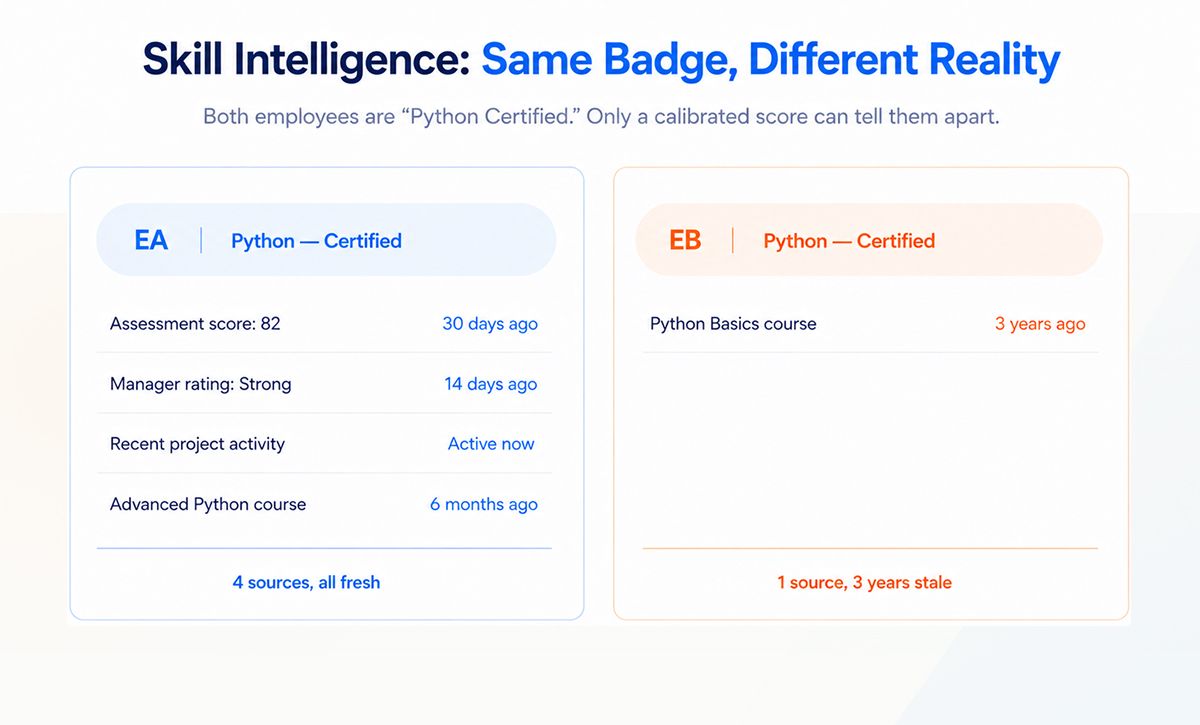
 

Identical badge, very different evidence behind it.

Picture two employees, both tagged “Python-Certified” in the HR system. The first earned that badge from a recent assessment score, a strong manager rating, active recent project work, and a completed advanced course: four sources, all current. The second earned it from a single Python Basics course, completed three years ago, and nothing since.

Both show up identically in a dashboard. Both would be pulled into the same shortlist if someone searched for “Python-certified employees” today. The badge doesn't know the difference, and if the underlying platform doesn't either, neither will the person making a staffing or promotion decision based on it.
 

Identical badge, very different evidence behind it.

Where Most “Skill Intelligence” Actually Comes From

Most platforms that claim skill intelligence are working from a single source dressed up as insight: one assessment vendor's score, or a tally of completed courses. That's not a minor limitation; it's the difference between a measurement and a rumor. A single-source score can't distinguish between the two employees above, because it was never designed to ask the questions that would.

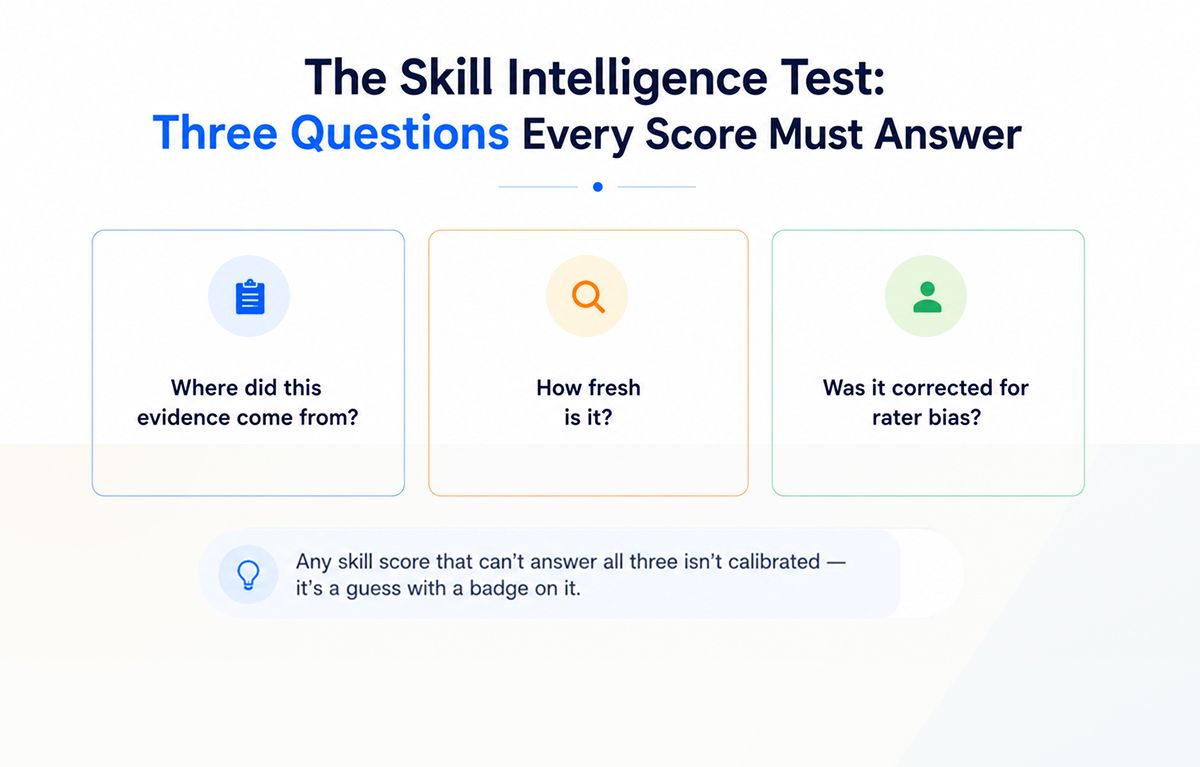
A genuine skill score has to survive three tests before it's trustworthy enough to inform a people decision: where did this evidence come from, how fresh is it, and was it corrected for the bias of whoever rated it? Most dashboards on the market today can't answer any of the three. Fewer still can answer all three for the same score.


Most platforms that claim skill intelligence are working from a single source dressed up as insight: one assessment vendor's score, or a tally of completed courses. That's not a minor limitation; it's the difference between a measurement and a rumor. A single-source score can't distinguish between the two employees above, because it was never designed to ask the questions that would.

A genuine skill score has to survive three tests before it's trustworthy enough to inform a people decision: where did this evidence come from, how fresh is it, and was it corrected for the bias of whoever rated it? Most dashboards on the market today can't answer any of the three. Fewer still can answer all three for the same score.


What Calibration Actually Requires

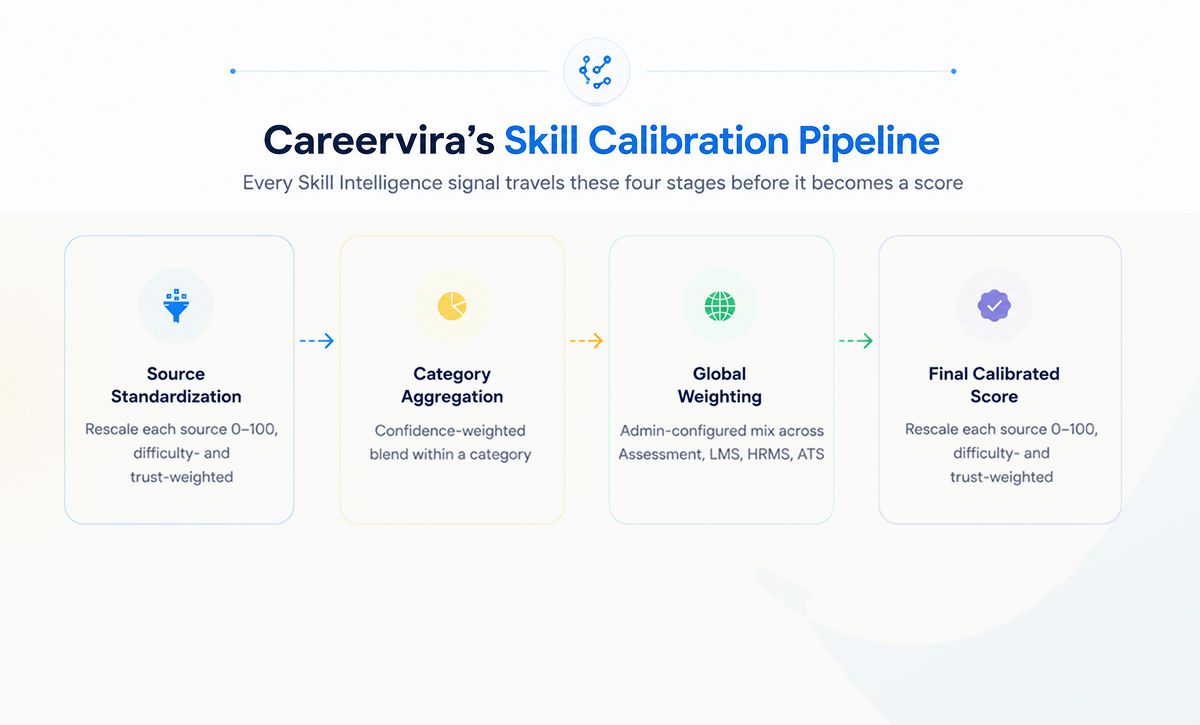
Getting a trustworthy answer means building a real pipeline, not a nicer chart. Every signal: a coding assessment, a manager rating, a certification, a CV line has to travel the same four stages before it becomes a score: standardized against its own source's scale and reliability, aggregated within its category with confidence weighting, blended across categories using a configurable global mix, and only then converted into a final calibrated score that can be audited back to its inputs.

This is the structural difference between a platform that has “AI-powered skills insight” as a marketing line and one that has calibration as an actual engineering pipeline. The four-stage version below is worth remembering; it recurs through the rest of this series wherever a score, a fairness claim, or an automated action depends on it.


The four-stage pipeline every signal has to travel before it becomes a score.

Getting a trustworthy answer means building a real pipeline, not a nicer chart. Every signal: a coding assessment, a manager rating, a certification, a CV line has to travel the same four stages before it becomes a score: standardized against its own source's scale and reliability, aggregated within its category with confidence weighting, blended across categories using a configurable global mix, and only then converted into a final calibrated score that can be audited back to its inputs.

This is the structural difference between a platform that has “AI-powered skills insight” as a marketing line and one that has calibration as an actual engineering pipeline. The four-stage version below is worth remembering; it recurs through the rest of this series wherever a score, a fairness claim, or an automated action depends on it.


The four-stage pipeline every signal has to travel before it becomes a score.

Skills Age. Scores Should Too.

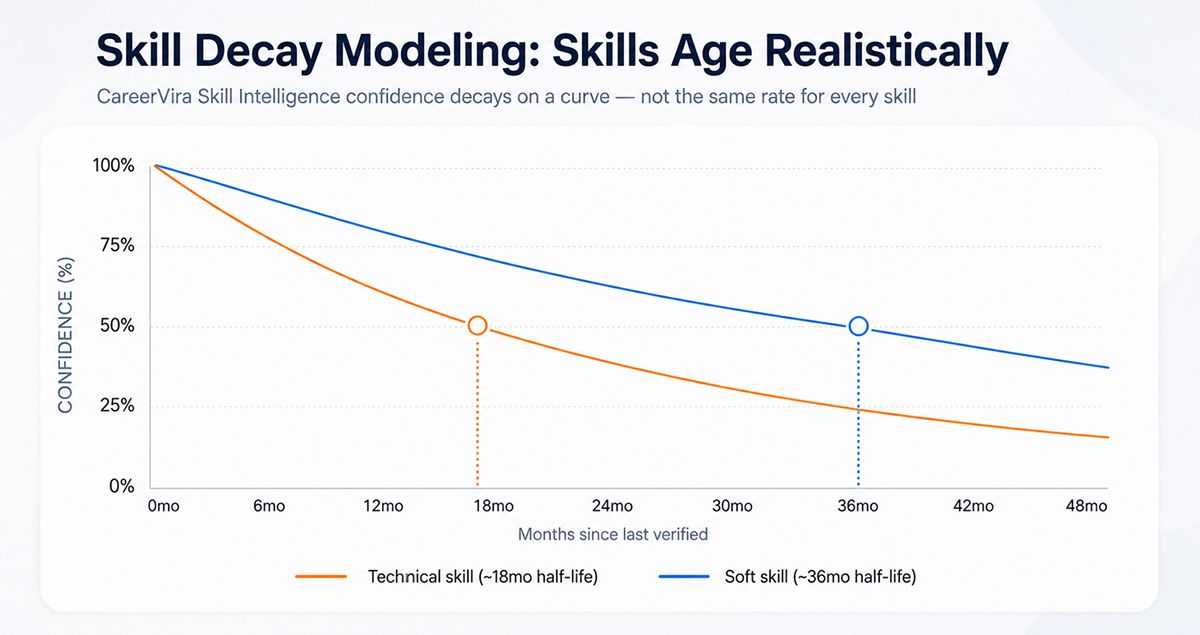
Freshness is the piece most platforms skip entirely. A certification earned three years ago and never used since shouldn't carry the same weight as one demonstrated last month; but in most systems, it does, because completion logs don't expire. Different skill types decay at different rates: technical skills lose half their confidence in roughly 18 months without reinforcement, while softer, more durable skills like communication or leadership decay more slowly, closer to a 36-month half-life.

Modeling decay isn't a cosmetic feature. It's the difference between a skill profile that reflects who someone is today and one that's really just an archive of who they used to be.


Confidence decays on a curve, and technical and soft skills don't decay at the same rate.

Freshness is the piece most platforms skip entirely. A certification earned three years ago and never used since shouldn't carry the same weight as one demonstrated last month; but in most systems, it does, because completion logs don't expire. Different skill types decay at different rates: technical skills lose half their confidence in roughly 18 months without reinforcement, while softer, more durable skills like communication or leadership decay more slowly, closer to a 36-month half-life.

Modeling decay isn't a cosmetic feature. It's the difference between a skill profile that reflects who someone is today and one that's really just an archive of who they used to be.


Confidence decays on a curve, and technical and soft skills don't decay at the same rate.

Before You Buy

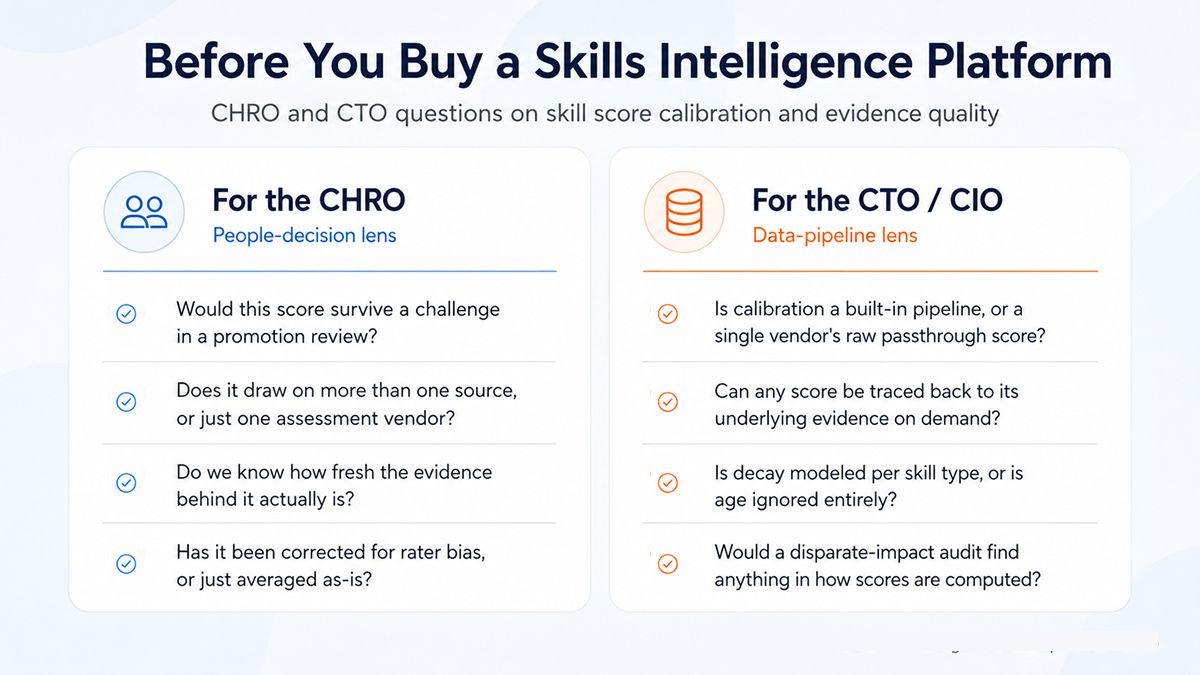
The stakes of an uncalibrated score land differently depending on the seat. A CHRO has to be able to defend a promotion decision if it's challenged; a CTO has to be able to explain what's actually happening inside the pipeline that produced the number in the first place.


Eight questions, two lenses — what to ask before any vendor conversation ends.


The stakes of an uncalibrated score land differently depending on the seat. A CHRO has to be able to defend a promotion decision if it's challenged; a CTO has to be able to explain what's actually happening inside the pipeline that produced the number in the first place.


Eight questions, two lenses — what to ask before any vendor conversation ends.


Features

Table of Contents

  • Description

  • Two Employees, One Badge

  • Where Most “Skill Intelligence” Actually Comes From

  • What Calibration Actually Requires

  • Skills Age. Scores Should Too.

  • Before You Buy