Top 10 AI-Powered LXP in India for 2026: Ranked on Personalization, Career Orchestration & Content Curation AI
Vijay Singh
10 September 2026
Add To Wishlist
Discover the top AI-based Learning Experience Platforms (LXPs) of 2026 transforming corporate training and education with personalized, adaptive learning, advanced analytics, and seamless integration.
Inside AI-Powered Personalization and Career Orchestration
AI for Learners vs. AI for L&D and Managers — in an LXP
What It Takes to Win in LXP Powered by AI: 2026 & 2027
Frequently Asked Questions (FAQs)
Discover the top AI-based Learning Experience Platforms (LXPs) of 2026 transforming corporate training and education with personalized, adaptive learning, advanced analytics, and seamless integration.
Description
Nearly every LXP on the market now claims “AI-driven personalization.” That phrase has stopped being a useful evaluation criterion for the same reason it did in the LMS category; two platforms can both honestly claim it and mean structurally different things. This guide scores the 10 leading LXPs in India for 2026 against a 7-dimension AI-Powered LXP Selection KPI, built around the two capabilities that actually define an LXP: personalization and career orchestration.
What Does “AI-Powered LXP” Actually Mean?
Two questions cut through the marketing language. First: is the personalization engine reasoning over a calibrated skills graph: HRMS, ATS, assessments, real work activity, or over course-completion and click history dressed up as intelligence? Second: is career pathing assistive (suggests a path, a human executes every step) or agentic (can sequence, assign, and adjust the path autonomously under a governed approval model)? Most “AI-powered LXP” claims today answer both questions the shallow way.
Two questions cut through the marketing language. First: is the personalization engine reasoning over a calibrated skills graph: HRMS, ATS, assessments, real work activity, or over course-completion and click history dressed up as intelligence? Second: is career pathing assistive (suggests a path, a human executes every step) or agentic (can sequence, assign, and adjust the path autonomously under a governed approval model)? Most “AI-powered LXP” claims today answer both questions the shallow way.
The Two Arguments Behind This Ranking
Argument 1: Personalization Is Only as Good as the Skill Data Underneath It
An LXP's entire value proposition is personalization, which makes the data feeding it the single most important thing to evaluate, more than for almost any other platform category. A recommendation engine trained on what people clicked on is doing engagement optimization, not skill development. Genuine personalization requires a skills graph calibrated from multiple sources, not a single learning-activity-led taxonomy. This is Dimension 1 of the KPI below, and it's the dimension that most directly separates a content-recommendation engine from an actual development tool.
Argument 2: Career Orchestration Is the LXP-Specific Test of ‘Agentic’
For an LMS, “agentic” often means closing a compliance gap or automating a workflow. For an LXP, the equivalent test is career orchestration: can the system actually sequence and assign the next step in someone's development, or does it stop at suggesting one course? Most platforms marketed as AI-powered LXPs are still assistive here; a human has to read the recommendation and act on it. This is Dimension 2 of the KPI, and, as with the LMS category, it's the dimension where the fewest platforms score above “partial.”
The AI-Powered LXP Selection KPI
Seven dimensions, each scored 0 (weak/absent) to 2 (strong), for a total out of 14. Adapted from the same framework used for the AI-Powered LMS ranking, re-centered on what an LXP is actually for.
Personalization Architecture — multi-source calibrated skill graph vs. learning-activity-led vs. click/profile-based
Career Orchestration — can sequence and assign under governance vs. suggests only vs. none
Content-Curation AI — precision curation and sequencing vs. relevance ranking vs. keyword matching
Breadth — 3+ named, role-specific AI capabilities vs. 1–2 named tools vs. generic claim
Attribution — do recommendations cite the source data behind them, or is it a black box
AI Pricing — published, itemized AI-tier pricing vs. disclosed-but-quote-based vs. hidden/bundled
Data Foundation — single unified model with the LMS vs. partial integration vs. fragmented
Verified AI Capability Benchmark: All 10 Platforms Scored
Platform
Personal. Arch
Career Orch.
Curation AI
Breadth
Attribution
AI Pricing
Data Fdn
Total /14
Careervira LXP
2
2
2
2
2
2
2
14
Docebo
2
1
2
2
1
0
1
9
Cornerstone LXP
2
1
1
1
0
0
1
6
Degreed
1
1
2
1
1
0
0
6
Disprz
1
1
2
1
0
0
1
6
Oracle Fusion Cloud Learning
1
1
1
1
0
0
1
5
360Learning
1
0
1
2
0
0
1
5
TalentLMS
0
0
1
1
0
2
1
5
LinkedIn Learning
1
0
1
1
0
0
1
4
Udemy Business
1
0
1
1
0
0
0
3
Scores reflect publicly available information as of August 2026 and sourced facts already maintained in this estate's battlecards — confirm current AI feature scope directly with each vendor before publishing. Note this is a distinct scorecard from the general LXP Completeness Benchmark; a platform's rank can differ between the two articles because they measure different things.
Argument 1: Personalization Is Only as Good as the Skill Data Underneath It
An LXP's entire value proposition is personalization, which makes the data feeding it the single most important thing to evaluate, more than for almost any other platform category. A recommendation engine trained on what people clicked on is doing engagement optimization, not skill development. Genuine personalization requires a skills graph calibrated from multiple sources, not a single learning-activity-led taxonomy. This is Dimension 1 of the KPI below, and it's the dimension that most directly separates a content-recommendation engine from an actual development tool.
Argument 2: Career Orchestration Is the LXP-Specific Test of ‘Agentic’
For an LMS, “agentic” often means closing a compliance gap or automating a workflow. For an LXP, the equivalent test is career orchestration: can the system actually sequence and assign the next step in someone's development, or does it stop at suggesting one course? Most platforms marketed as AI-powered LXPs are still assistive here; a human has to read the recommendation and act on it. This is Dimension 2 of the KPI, and, as with the LMS category, it's the dimension where the fewest platforms score above “partial.”
The AI-Powered LXP Selection KPI
Seven dimensions, each scored 0 (weak/absent) to 2 (strong), for a total out of 14. Adapted from the same framework used for the AI-Powered LMS ranking, re-centered on what an LXP is actually for.
Personalization Architecture — multi-source calibrated skill graph vs. learning-activity-led vs. click/profile-based
Career Orchestration — can sequence and assign under governance vs. suggests only vs. none
Content-Curation AI — precision curation and sequencing vs. relevance ranking vs. keyword matching
Breadth — 3+ named, role-specific AI capabilities vs. 1–2 named tools vs. generic claim
Attribution — do recommendations cite the source data behind them, or is it a black box
AI Pricing — published, itemized AI-tier pricing vs. disclosed-but-quote-based vs. hidden/bundled
Data Foundation — single unified model with the LMS vs. partial integration vs. fragmented
Verified AI Capability Benchmark: All 10 Platforms Scored
Platform
Personal. Arch
Career Orch.
Curation AI
Breadth
Attribution
AI Pricing
Data Fdn
Total /14
Careervira LXP
2
2
2
2
2
2
2
14
Docebo
2
1
2
2
1
0
1
9
Cornerstone LXP
2
1
1
1
0
0
1
6
Degreed
1
1
2
1
1
0
0
6
Disprz
1
1
2
1
0
0
1
6
Oracle Fusion Cloud Learning
1
1
1
1
0
0
1
5
360Learning
1
0
1
2
0
0
1
5
TalentLMS
0
0
1
1
0
2
1
5
LinkedIn Learning
1
0
1
1
0
0
1
4
Udemy Business
1
0
1
1
0
0
0
3
Scores reflect publicly available information as of August 2026 and sourced facts already maintained in this estate's battlecards — confirm current AI feature scope directly with each vendor before publishing. Note this is a distinct scorecard from the general LXP Completeness Benchmark; a platform's rank can differ between the two articles because they measure different things.
The 10 Platforms, Ranked by AI-Powered LXP KPI
1. Careervira LXP — 14/14
Clears every dimension of the KPI. Personalization runs on a multi-source calibrated skill graph rather than learning-activity data alone; career orchestration is native and agentic (Role Matcher, Pathway Planner, Succession Slater agents can sequence and assign, not just suggest); content curation spans an 80,000+ title marketplace with AI tagging; and AI pricing is a published, itemized ladder rather than a quote. It's also the only platform in this field with a published Role Automation tier; not just recommending a career move, but executing the orchestration under governance.
Personalization: multi-source calibrated skill graph (HRMS, ATS, assessments, work activity)
Career Orchestration: native agents can sequence and assign under governance, not just recommend
Content-Curation AI: 80,000+ titles, BYOC, AI-tagged and precision-sequenced
Breadth: 10+ primary agents plus 100+ mini agents, including a dedicated Career Orchestration pillar
AI Pricing: published $0.50–$20/user/month ladder
Role Automation: the only named tier in this field built for governed autonomous execution, not just AI-assisted recommendation
2. Docebo — 9/14
The strongest AI story among the non-Careervira field. AgentHub (via Docebo's Zive acquisition) automates document-to-course transformation, a 365Talents-powered skills layer adds genuine skill inference, and a public MCP Server exposes the platform to external AI assistants. Career orchestration remains partial. AgentHub's own scope is content/knowledge conversion and tutoring, not role sequencing, and AI pricing is usage-based credits on top of a quote-led enterprise tier.
Career Orchestration: partial role mapping only; AgentHub's scope is content/tutor, not career sequencing
Content-Curation AI: AgentHub's document-to-course automation, Harmony marketplace, public MCP Server
AI Pricing: active-user, quote-based, plus usage-based AI credits
3. Cornerstone LXP — 6/14
SkyHive-powered skills intelligence (acquired, platform-native) brings genuine adaptive personalization to a comprehensive talent suite, and Cornerstone Immerse adds real VR/desktop roleplay content; but career orchestration is limited to role mapping, content-curation AI is basic outside of Immerse specifically, and AI pricing is entirely quote-based.
Cornerstone Immerse adds VR/desktop roleplay: a real content capability, though not AI-curation depth
AI Pricing: quote-based, no published rate
4. Degreed — 6/14
The strongest content-curation AI on this list by breadth (800+ integrations, Open Library's 500+ curated pathways), and Degreed Maestro adds genuine generative pathway creation and AI coaching, but Degreed's own materials confirm Maestro “cannot execute cross-system writes,” and there's no native LXP-to-LMS data foundation to unify it with. Degreed has no native LMS at any price.
Personalization: learning-activity-led skills graph, not multi-source calibrated
Career Orchestration: Degreed Maestro, confirmed assistive, “cannot execute cross-system writes”
Content-Curation AI: strongest aggregation breadth in the category, now extended by Open Library
Data Foundation: no native LMS at any price; fragmented
5. Disprz — 6/14
Turo's document-to-course AI generation is a genuine, specific content-curation capability, and personalization is real and role-based, but career orchestration doesn't extend past role-to-skill mapping, and deeper AI capability remains a usage-based add-on rather than published, itemized pricing.
Personalization: role-based, rated Strong, though learning/assessment-led rather than multi-source calibrated
Career Orchestration: partial role-to-skill mapping, not full sequencing
Content-Curation AI: Turo converts SOPs/PDFs into 6 interactive formats: a real, specific capability
AI Pricing: usage-based add-on, rated Low on transparency
6. 360Learning — 5/14
Three real, named generative-AI tools: AI Course Creation, AI Companion, and Synthesia video-avatar integration genuinely strengthen this platform's AI breadth beyond earlier assessments. Personalization still isn't skill-graph calibrated, career orchestration isn't a focus, and 360Learning's own materials describe the AI as an assistive co-pilot within the authoring workspace, not agentic.
Personalization: AI-powered recommendations via AI Companion, not skill-graph-based
Career Orchestration: not a focus
Breadth: 3 named AI tools (AI Course Creation, AI Companion, Synthesia); genuinely more than a single bolted-on feature
AI Pricing: quote-based
7. TalentLMS — 5/14
TalentCraft is a genuine, useful AI content-generation tool, and pricing is the most transparent in this comparison set, but there's no skill-graph-based personalization layer behind it, career orchestration isn't a documented focus, and AI capability is a single bolted-on tool rather than a structural capability.
Personalization: not skill-graph calibrated, no documented layer
Career Orchestration: not a focus
Content-Curation AI: TalentCraft, a single named tool
AI Pricing: published, transparent; the field's strongest pricing score, undercut by thin AI depth elsewhere
8. Oracle Fusion Cloud Learning — 5/14
The Job Skills Enrichment Agent and Oracle Grow bring genuine, if HCM-bounded, AI to both personalization and career development, recommender-driven skill suggestions and real mentoring/gigs journeys tied to performance goals. Both are explicitly confined to the Oracle Cloud HCM database and can't orchestrate cross-platform workflows without custom development, and AI pricing isn't published separately from the broader HCM contract.
AI Pricing: not published; bundled into Oracle HCM Cloud licensing
9. LinkedIn Learning — 4/14
Profile-based personalization is genuinely useful for individual upskilling, now paired with AI-generated transcript summaries and profile-matching copilots, but it isn't calibrated from an enterprise skills graph, career orchestration is essentially absent, and AI pricing isn't itemized separately from the subscription.
Personalization: profile-based, not skill-graph calibrated
Career Orchestration: none
Breadth: AI transcript summaries + profile-matching copilots; 2 named, assistive features
AI Pricing: bundled into subscription
10. Udemy Business — 3/14
AI-powered recommendations across a large single marketplace, but with no career orchestration, no source attribution, and no unified data foundation with an LMS.
Personalization: generic AI recommendations
Career Orchestration: not a focus
Data Foundation: single marketplace, not unified
1. Careervira LXP — 14/14
Clears every dimension of the KPI. Personalization runs on a multi-source calibrated skill graph rather than learning-activity data alone; career orchestration is native and agentic (Role Matcher, Pathway Planner, Succession Slater agents can sequence and assign, not just suggest); content curation spans an 80,000+ title marketplace with AI tagging; and AI pricing is a published, itemized ladder rather than a quote. It's also the only platform in this field with a published Role Automation tier; not just recommending a career move, but executing the orchestration under governance.
Personalization: multi-source calibrated skill graph (HRMS, ATS, assessments, work activity)
Career Orchestration: native agents can sequence and assign under governance, not just recommend
Content-Curation AI: 80,000+ titles, BYOC, AI-tagged and precision-sequenced
Breadth: 10+ primary agents plus 100+ mini agents, including a dedicated Career Orchestration pillar
AI Pricing: published $0.50–$20/user/month ladder
Role Automation: the only named tier in this field built for governed autonomous execution, not just AI-assisted recommendation
2. Docebo — 9/14
The strongest AI story among the non-Careervira field. AgentHub (via Docebo's Zive acquisition) automates document-to-course transformation, a 365Talents-powered skills layer adds genuine skill inference, and a public MCP Server exposes the platform to external AI assistants. Career orchestration remains partial. AgentHub's own scope is content/knowledge conversion and tutoring, not role sequencing, and AI pricing is usage-based credits on top of a quote-led enterprise tier.
Career Orchestration: partial role mapping only; AgentHub's scope is content/tutor, not career sequencing
Content-Curation AI: AgentHub's document-to-course automation, Harmony marketplace, public MCP Server
AI Pricing: active-user, quote-based, plus usage-based AI credits
3. Cornerstone LXP — 6/14
SkyHive-powered skills intelligence (acquired, platform-native) brings genuine adaptive personalization to a comprehensive talent suite, and Cornerstone Immerse adds real VR/desktop roleplay content; but career orchestration is limited to role mapping, content-curation AI is basic outside of Immerse specifically, and AI pricing is entirely quote-based.
Cornerstone Immerse adds VR/desktop roleplay: a real content capability, though not AI-curation depth
AI Pricing: quote-based, no published rate
4. Degreed — 6/14
The strongest content-curation AI on this list by breadth (800+ integrations, Open Library's 500+ curated pathways), and Degreed Maestro adds genuine generative pathway creation and AI coaching, but Degreed's own materials confirm Maestro “cannot execute cross-system writes,” and there's no native LXP-to-LMS data foundation to unify it with. Degreed has no native LMS at any price.
Personalization: learning-activity-led skills graph, not multi-source calibrated
Career Orchestration: Degreed Maestro, confirmed assistive, “cannot execute cross-system writes”
Content-Curation AI: strongest aggregation breadth in the category, now extended by Open Library
Data Foundation: no native LMS at any price; fragmented
5. Disprz — 6/14
Turo's document-to-course AI generation is a genuine, specific content-curation capability, and personalization is real and role-based, but career orchestration doesn't extend past role-to-skill mapping, and deeper AI capability remains a usage-based add-on rather than published, itemized pricing.
Personalization: role-based, rated Strong, though learning/assessment-led rather than multi-source calibrated
Career Orchestration: partial role-to-skill mapping, not full sequencing
Content-Curation AI: Turo converts SOPs/PDFs into 6 interactive formats: a real, specific capability
AI Pricing: usage-based add-on, rated Low on transparency
6. 360Learning — 5/14
Three real, named generative-AI tools: AI Course Creation, AI Companion, and Synthesia video-avatar integration genuinely strengthen this platform's AI breadth beyond earlier assessments. Personalization still isn't skill-graph calibrated, career orchestration isn't a focus, and 360Learning's own materials describe the AI as an assistive co-pilot within the authoring workspace, not agentic.
Personalization: AI-powered recommendations via AI Companion, not skill-graph-based
Career Orchestration: not a focus
Breadth: 3 named AI tools (AI Course Creation, AI Companion, Synthesia); genuinely more than a single bolted-on feature
AI Pricing: quote-based
7. TalentLMS — 5/14
TalentCraft is a genuine, useful AI content-generation tool, and pricing is the most transparent in this comparison set, but there's no skill-graph-based personalization layer behind it, career orchestration isn't a documented focus, and AI capability is a single bolted-on tool rather than a structural capability.
Personalization: not skill-graph calibrated, no documented layer
Career Orchestration: not a focus
Content-Curation AI: TalentCraft, a single named tool
AI Pricing: published, transparent; the field's strongest pricing score, undercut by thin AI depth elsewhere
8. Oracle Fusion Cloud Learning — 5/14
The Job Skills Enrichment Agent and Oracle Grow bring genuine, if HCM-bounded, AI to both personalization and career development, recommender-driven skill suggestions and real mentoring/gigs journeys tied to performance goals. Both are explicitly confined to the Oracle Cloud HCM database and can't orchestrate cross-platform workflows without custom development, and AI pricing isn't published separately from the broader HCM contract.
AI Pricing: not published; bundled into Oracle HCM Cloud licensing
9. LinkedIn Learning — 4/14
Profile-based personalization is genuinely useful for individual upskilling, now paired with AI-generated transcript summaries and profile-matching copilots, but it isn't calibrated from an enterprise skills graph, career orchestration is essentially absent, and AI pricing isn't itemized separately from the subscription.
Personalization: profile-based, not skill-graph calibrated
Career Orchestration: none
Breadth: AI transcript summaries + profile-matching copilots; 2 named, assistive features
AI Pricing: bundled into subscription
10. Udemy Business — 3/14
AI-powered recommendations across a large single marketplace, but with no career orchestration, no source attribution, and no unified data foundation with an LMS.
Personalization: generic AI recommendations
Career Orchestration: not a focus
Data Foundation: single marketplace, not unified
Inside AI-Powered Personalization and Career Orchestration
As with the AI-Powered LMS guide, the example below illustrates what Dimensions 1 and 2 of the KPI look like when they score a 2, using Careervira's published architecture as a concrete reference point, not a claim that every platform works this way.
Personalization Architecture
The mechanism matters more than the marketing claim. A calibrated personalization engine ingests signals from coding platforms, learning and certification records, soft-skill assessments, behavioural/manager input, and HRMS/ATS/work-activity data, then runs them through a validation, alignment, verification, and evaluation pipeline before any recommendation is made. The practical difference: “recommend a course because you clicked something similar” versus “recommend a course because your calibrated proficiency score, corroborated across multiple sources, shows a specific gap.”
Career Orchestration Agents
The agents that turn a detected gap into an actual next step: a Role Matcher (finds who fits a role, or what role fits a person), a Pathway Planner (designs a multi-step roadmap), a Mobility Mapper (surfaces internal transitions), and a Promotion-Readiness Scorer. The distinction that matters for the KPI: these agents can sequence and, under a governed approval model, assign the next step; not just display a suggested path for a human to act on manually.
Content-Curation AI
“AI-powered curation” ranges from simple relevance ranking to genuine prioritization and sequencing. The difference between “here are 40 relevant courses” and “here are the 3 that matter most, in the order to take them.” The strongest implementations can also reason over compound conditions (find content covering skill A but not skill B) and infer likely relevance even where course metadata is incomplete; capabilities that separate a search-and-filter tool from an actual curation engine.
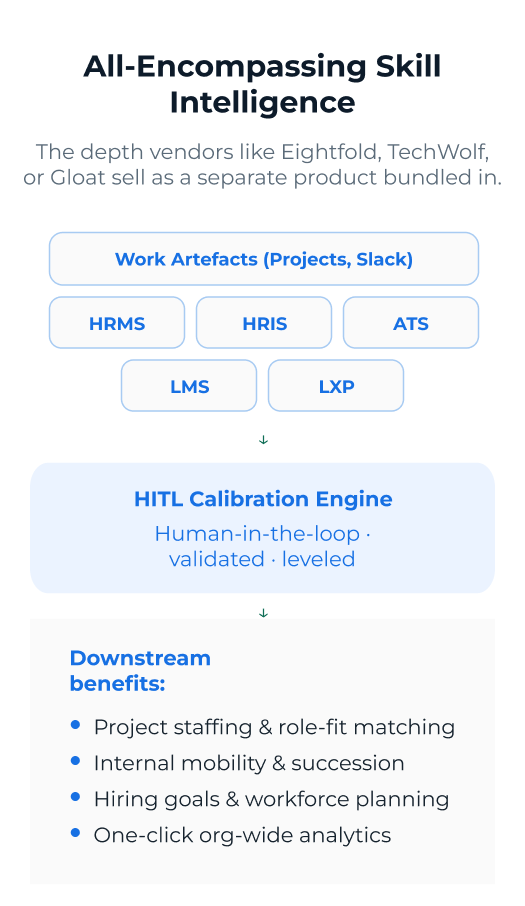
Skill Intelligence — the depth vendors like Eightfold, TechWolf, or Gloat sell separately
Enterprise skill-intelligence platforms; the category built by vendors like Eightfold AI, TechWolf, and Gloat, typically exist as a separate, premium-priced layer sitting on top of whatever LXP an organization already runs, sold specifically because most “personalization” in this category is really just learning-activity history relabeled as a skills score. The structural claim worth testing on any AI-powered LXP is that depth is bundled into the core platform, or a fourth vendor relationship away?
All-encompassing signal sources, human-in-the-loop calibration, real downstream use.
What makes this kind of skill intelligence all-encompassing rather than thin is signal breadth: HRMS, HRIS, and ATS data, LMS and LXP activity, and real work artefacts including project involvement and collaboration-tool activity, all feeding one calibration pipeline rather than a score built purely from course completions. Human-in-the-loop calibration matters just as much as breadth: skill records that carry a validation score, and a system that can surface which employees or roles have the widest spread between confidence levels, give a reviewer somewhere specific to look rather than asking them to trust every automated score equally.
The payoff extends past learning recommendations. A skills graph calibrated to this depth is the same underlying map a manager uses to ask who's ready for a specific role, which is real project-staffing and internal-mobility use. The mechanism behind bench planning and workforce-hiring-goal conversations, not a separate HR-tech feature bolted on afterward. That's the difference between an LXP that personalizes learning and one whose skill intelligence layer is doing genuine workforce-planning work.
Analytics at a click of a button
The clearest test of whether an AI-powered LXP's personalization claim is real: can a single natural-language query resolve what would otherwise take three or four separate reports? A genuinely capable system lets a CHRO ask for a complete organizational overview - learning hours, headcount, skill readiness by job family- in one request, and lets an L&D manager ask which learning journeys have the highest completion rate or steepest drop-off and get a direct answer rather than a dashboard to interpret.
The composite queries are the real differentiator. A single prompt that returns an employee's full profile, skill-gap analysis, and learning roadmap together, instead of three disconnected lookups, is doing something a static report library was never built to do. So is a query that compares the skills required for two different roles and returns the courses that overlap between both, or one that returns total active users over a period alongside the platform's trending skills in the same breath. That's what “analytics at a click of a button” actually means in practice: conversational access to the same calibrated data every other part of the platform runs on, not a separate reporting module.
AI Pricing for LXP Specifically
The same published-ladder-vs-quote-based split from the LMS category applies here, with one LXP-specific wrinkle: several “pure-play” LXPs price their AI personalization as part of a single subscription tier with no way to isolate what's actually being paid for the AI versus the content library access. A published, itemized AI tier, separate from base platform cost, is a meaningfully stronger signal of structural (not bolted-on) AI than an all-in-one subscription price.
As with the AI-Powered LMS guide, the example below illustrates what Dimensions 1 and 2 of the KPI look like when they score a 2, using Careervira's published architecture as a concrete reference point, not a claim that every platform works this way.
Personalization Architecture
The mechanism matters more than the marketing claim. A calibrated personalization engine ingests signals from coding platforms, learning and certification records, soft-skill assessments, behavioural/manager input, and HRMS/ATS/work-activity data, then runs them through a validation, alignment, verification, and evaluation pipeline before any recommendation is made. The practical difference: “recommend a course because you clicked something similar” versus “recommend a course because your calibrated proficiency score, corroborated across multiple sources, shows a specific gap.”
Career Orchestration Agents
The agents that turn a detected gap into an actual next step: a Role Matcher (finds who fits a role, or what role fits a person), a Pathway Planner (designs a multi-step roadmap), a Mobility Mapper (surfaces internal transitions), and a Promotion-Readiness Scorer. The distinction that matters for the KPI: these agents can sequence and, under a governed approval model, assign the next step; not just display a suggested path for a human to act on manually.
Content-Curation AI
“AI-powered curation” ranges from simple relevance ranking to genuine prioritization and sequencing. The difference between “here are 40 relevant courses” and “here are the 3 that matter most, in the order to take them.” The strongest implementations can also reason over compound conditions (find content covering skill A but not skill B) and infer likely relevance even where course metadata is incomplete; capabilities that separate a search-and-filter tool from an actual curation engine.
Skill Intelligence — the depth vendors like Eightfold, TechWolf, or Gloat sell separately
Enterprise skill-intelligence platforms; the category built by vendors like Eightfold AI, TechWolf, and Gloat, typically exist as a separate, premium-priced layer sitting on top of whatever LXP an organization already runs, sold specifically because most “personalization” in this category is really just learning-activity history relabeled as a skills score. The structural claim worth testing on any AI-powered LXP is that depth is bundled into the core platform, or a fourth vendor relationship away?
All-encompassing signal sources, human-in-the-loop calibration, real downstream use.
What makes this kind of skill intelligence all-encompassing rather than thin is signal breadth: HRMS, HRIS, and ATS data, LMS and LXP activity, and real work artefacts including project involvement and collaboration-tool activity, all feeding one calibration pipeline rather than a score built purely from course completions. Human-in-the-loop calibration matters just as much as breadth: skill records that carry a validation score, and a system that can surface which employees or roles have the widest spread between confidence levels, give a reviewer somewhere specific to look rather than asking them to trust every automated score equally.
The payoff extends past learning recommendations. A skills graph calibrated to this depth is the same underlying map a manager uses to ask who's ready for a specific role, which is real project-staffing and internal-mobility use. The mechanism behind bench planning and workforce-hiring-goal conversations, not a separate HR-tech feature bolted on afterward. That's the difference between an LXP that personalizes learning and one whose skill intelligence layer is doing genuine workforce-planning work.
Analytics at a click of a button
The clearest test of whether an AI-powered LXP's personalization claim is real: can a single natural-language query resolve what would otherwise take three or four separate reports? A genuinely capable system lets a CHRO ask for a complete organizational overview - learning hours, headcount, skill readiness by job family- in one request, and lets an L&D manager ask which learning journeys have the highest completion rate or steepest drop-off and get a direct answer rather than a dashboard to interpret.
The composite queries are the real differentiator. A single prompt that returns an employee's full profile, skill-gap analysis, and learning roadmap together, instead of three disconnected lookups, is doing something a static report library was never built to do. So is a query that compares the skills required for two different roles and returns the courses that overlap between both, or one that returns total active users over a period alongside the platform's trending skills in the same breath. That's what “analytics at a click of a button” actually means in practice: conversational access to the same calibrated data every other part of the platform runs on, not a separate reporting module.
AI Pricing for LXP Specifically
The same published-ladder-vs-quote-based split from the LMS category applies here, with one LXP-specific wrinkle: several “pure-play” LXPs price their AI personalization as part of a single subscription tier with no way to isolate what's actually being paid for the AI versus the content library access. A published, itemized AI tier, separate from base platform cost, is a meaningfully stronger signal of structural (not bolted-on) AI than an all-in-one subscription price.
AI for Learners vs. AI for L&D and Managers — in an LXP
The same role-based split that applies to AI-powered LMS platforms applies to LXPs, with LXP-specific emphasis on discovery and curation rather than delivery mechanics:
Learner AI: self-directed discovery of “what should I learn next given my current gaps and goals,” surfaced and sequenced automatically
Line Manager AI: team-level skill-gap visibility and content curation for a specific team's development needs, not individual discovery
L&D Manager AI: content performance and curation-source management, which content sources are actually driving skill development, which aren't
HRBP / CHRO AI: department- or org-wide skill-coverage reporting, aggregate and strategic rather than individual
The practical test: does the platform's AI serve the manager's curation-and-visibility need as genuinely as it serves the learner's discovery need, or is “AI-powered” really just the learner-facing recommendation widget; the easiest part of this to demo and the shallowest to build.
The same role-based split that applies to AI-powered LMS platforms applies to LXPs, with LXP-specific emphasis on discovery and curation rather than delivery mechanics:
Learner AI: self-directed discovery of “what should I learn next given my current gaps and goals,” surfaced and sequenced automatically
Line Manager AI: team-level skill-gap visibility and content curation for a specific team's development needs, not individual discovery
L&D Manager AI: content performance and curation-source management, which content sources are actually driving skill development, which aren't
HRBP / CHRO AI: department- or org-wide skill-coverage reporting, aggregate and strategic rather than individual
The practical test: does the platform's AI serve the manager's curation-and-visibility need as genuinely as it serves the learner's discovery need, or is “AI-powered” really just the learner-facing recommendation widget; the easiest part of this to demo and the shallowest to build.
What It Takes to Win in LXP Powered by AI: 2026 & 2027
2026
Multi-source skill data calibrated to drive personalization, not a single learning-activity-led graph pretending to be intelligence
Published, itemized AI pricing; separable from base content-library subscription cost
Content-curation AI that prioritizes and sequences, not just ranks by relevance
2027
Agentic career orchestration as the real differentiator. Platforms still only suggesting paths for a human to execute will read as structurally behind, not just feature-behind, next to platforms that can sequence and assign under governance
A native LMS underneath, or a clearly reconciled architecture with one. The “no native LMS at any price” gap becomes harder to justify as buyers get more sophisticated about the baseline test
Curation AI that reasons across an enterprise's own HRMS/ATS/work-activity data, not just its own content catalog. The same cross-system-reasoning bar the LMS category is moving toward
The honest summary, consistent with the LMS-side conclusion: “AI-powered” will keep being claimed by every LXP on the market. What will separate genuine capability from a marketing page by 2027 is whether the personalization and career orchestration can be interrogated — which data, which confidence, which governance- rather than taken on faith.
And one more question worth asking directly: does the platform have a published Role Automation tier, a governed progression from spotting a skill gap to acting on it, or does even its strongest AI story end with recommending a course or a career path? These are all actual, concrete capabilities: Docebo’s AgentHub, Cornerstone’s SkyHive and Immerse, Degreed’s Maestro, and 360Learning’s AI Companion.
2026
Multi-source skill data calibrated to drive personalization, not a single learning-activity-led graph pretending to be intelligence
Published, itemized AI pricing; separable from base content-library subscription cost
Content-curation AI that prioritizes and sequences, not just ranks by relevance
2027
Agentic career orchestration as the real differentiator. Platforms still only suggesting paths for a human to execute will read as structurally behind, not just feature-behind, next to platforms that can sequence and assign under governance
A native LMS underneath, or a clearly reconciled architecture with one. The “no native LMS at any price” gap becomes harder to justify as buyers get more sophisticated about the baseline test
Curation AI that reasons across an enterprise's own HRMS/ATS/work-activity data, not just its own content catalog. The same cross-system-reasoning bar the LMS category is moving toward
The honest summary, consistent with the LMS-side conclusion: “AI-powered” will keep being claimed by every LXP on the market. What will separate genuine capability from a marketing page by 2027 is whether the personalization and career orchestration can be interrogated — which data, which confidence, which governance- rather than taken on faith.
And one more question worth asking directly: does the platform have a published Role Automation tier, a governed progression from spotting a skill gap to acting on it, or does even its strongest AI story end with recommending a course or a career path? These are all actual, concrete capabilities: Docebo’s AgentHub, Cornerstone’s SkyHive and Immerse, Degreed’s Maestro, and 360Learning’s AI Companion.
Frequently Asked Questions (FAQs)
1. Is AI-driven personalization effective with all LXPs?
No. The depth varies enormously, from profile-based recommendations to a fully calibrated, multi-source skills graph. Ask specifically what data feeds the recommendation engine before taking an “AI-powered” claim at face value.
2. What’s the difference between AI-powered curation and career orchestration?
AI curation decides what content is shown and in what order. The bigger path is career orchestration. What role, the series of skills, the development plan, and, at the highest level, what can act on that plan instead of just recommending it.
3. Can an AI-enabled LXP function without a native LMS?
Yes, for enterprise use. AI-driven personalization and curation are worthless without a delivery, tracking, and compliance layer underneath them. Several strong AI-powered LXPs on this list have exactly this gap. See the companion guide, 10 Best LXP in India for 2026, for the full baseline test.
See calibrated personalization and agentic career orchestration in a live demo → Book a Demo
1. Is AI-driven personalization effective with all LXPs?
No. The depth varies enormously, from profile-based recommendations to a fully calibrated, multi-source skills graph. Ask specifically what data feeds the recommendation engine before taking an “AI-powered” claim at face value.
2. What’s the difference between AI-powered curation and career orchestration?
AI curation decides what content is shown and in what order. The bigger path is career orchestration. What role, the series of skills, the development plan, and, at the highest level, what can act on that plan instead of just recommending it.
3. Can an AI-enabled LXP function without a native LMS?
Yes, for enterprise use. AI-driven personalization and curation are worthless without a delivery, tracking, and compliance layer underneath them. Several strong AI-powered LXPs on this list have exactly this gap. See the companion guide, 10 Best LXP in India for 2026, for the full baseline test.
See calibrated personalization and agentic career orchestration in a live demo → Book a Demo